The AAA Licence
Assist, Augment, Adapt: earning the right to deploy higher-agency AI.
Part 2: The Licence
Position Is Not Permission
Part 1 gave you the map.
You can now look at an AI portfolio and see its shape. You can tell whether an organisation is scattered across the grid, anchored in low-agency work, concentrated around a defensible capability, or drifting without intent. You can see whether the work belongs in ASSIST, AUGMENT, or ADAPT. You can see whether the portfolio is becoming a Spear, a Shield, a Spiral, or a Star.
That is useful. It is not enough.
A position on the map is not a licence to race there.
This is the mistake most organisations make with AI. They confuse destination with qualification. They look at Q3, Q6 or Q9 and say, "That is where we need to be." They buy tools that promise autonomy. They fund pilots that look like transformation. They announce agentic roadmaps, automated workflows, self-optimising systems, and AI copilots that will become AI colleagues.
But ambition is not capability.
In Formula 1, no one gets to Monaco because they can describe the racing line. No one gets a seat because they bought a faster car. Before a driver is allowed near the grid, they must accumulate proof: lower formulas, race craft, judgement under pressure, safety discipline, points earned over years. The licence is not a formality. It is the accumulated evidence that speed will not become recklessness.
AI needs the same discipline.
The Licence is the question Part 2 asks:
Have you earned the right to operate at the level of agency you are attempting?
That right is not granted by software spend. It is not granted by executive urgency. It is not granted by vendor demos, strategy decks, or the fact that competitors are moving. It is earned through capability, governance, and trust.
The three chapters in this section work together:
The AAA Licence defines the maturity ladder: ASSIST, AUGMENT, ADAPT. It shows why higher agency must be earned, not declared, and why most organisations should climb like Piastri rather than imitate Verstappen.
The Readiness Gates turn maturity into evidence. They ask what must be proven before a system moves up: problem clarity, governance exercised, integration resilience, value measured, and capability transferable.
Trust Capital explains the currency underneath all of it. Even when the model is right, people will not act on it unless trust has been built, protected, and compounded.
Together, these form the operating licence for co-intelligence:
- What level of maturity have you earned?
- What proof shows you are ready to move up?
- How much trust can you safely spend?
Without those answers, the 9Q Grid becomes a wish list. With them, it becomes a controlled progression.
That is the shift from Part 1 to Part 2. The Map shows where value might be. The Licence tells you whether you are qualified to go there.
Position is not permission.
Permission is earned.
Two Paths to Monaco
In 2017, a 16-year-old Australian named Oscar Piastri finished second in the British Formula 4 Championship. Six wins. Six pole positions. A promising start.
What happened next would become a masterclass in patience.
2019: Piastri won the Formula Renault Eurocup. 2020: He won the FIA Formula 3 Championship—in his rookie year. 2021: He won the FIA Formula 2 Championship—again, in his rookie year.
Those three titles came in consecutive seasons. By the time he reached Formula 1, he had proven that he could handle the speed at each level. The exact sequence was his route to the grid, not a compulsory path for every driver.
In 2025, Piastri led the F1 World Championship for a substantial part of the season. He won seven Grands Prix and finished third in the final standings, just 13 points behind champion Lando Norris and 11 behind Max Verstappen.
Piastri climbed the ladder. Every rung. Every test. Every proof of competence.
Now consider Max Verstappen.
In 2014, Verstappen competed in his first full season of single-seater racing in the FIA Formula 3 European Championship. He finished third.
The next year, he was in Formula 1.
Verstappen skipped Formula 2 entirely. He went straight from F3 to the pinnacle of motorsport—becoming the youngest driver in F1 history at 17 years and 166 days.
A new Super Licence points system took effect in 2016, with a minimum age of 18 and a requirement to earn 40 points through qualifying competition results. The FIA later added discretion for exceptional 17-year-olds. Verstappen remains the youngest driver to have started a Grand Prix.
Verstappen skipped the ladder. And it worked—because he was Max Verstappen.
Here's the question that defines Part 2 of this book:
Which path should your organisation take?
Part 1 showed you where your portfolio sits on the map: the 9Q Grid, the failure shapes, and the strategic shapes that emerge when agency and impact are deliberately arranged. The Licence asks a harder question: have you actually earned the right to operate at that position?
The Exception Is Not the Rule
Every executive has heard of the startup that went from idea to IPO in three years. Every AI leader has heard of the project that went from pilot to production in six months.
These stories are seductive. They suggest that the ladder is optional. That if you're good enough, talented enough, ambitious enough, you can skip the boring middle steps.
This thinking destroys organisations.
Max Verstappen could skip F2 because he was already, at 17, one of the fastest drivers on the planet. His father, Jos Verstappen, was a former F1 driver who had trained him since childhood. He had raced go-karts at a world-class level for a decade. He was exceptional.
But here's what the Verstappen story obscures:
His success does not tell you how an unprepared driver would perform. The later licence requirements formalised the evidence a newcomer must normally bring. They did not require everyone to reproduce Piastri's exact route.
For an organisation, the lesson is to prove the underlying capability before increasing the authority of its systems.
In AI deployment, the ladder is the Readiness Gates. And most organisations are trying to be Verstappen when they're not even Piastri yet.
The Ladder of Maturity
Oscar Piastri didn't just win championships. He passed tests.
At each level—F4, Formula Renault, F3, F2—he proved something specific:
| Stage in Piastri's route | Capability the chapter draws from it |
|---|---|
| F4 | Learning to race in single-seaters |
| Formula Renault | Building consistency in a different car |
| F3 | Performing in a stronger international field |
| F2 | Sustaining performance under championship pressure |
| F1 | Applying that preparation at the highest level |
These are lessons from his progression. They are not the FIA's scoring rubric.
The AAA Licence applies the same logic to AI deployment.
AAA is the ladder: ASSIST, AUGMENT, ADAPT. The Licence is the right to climb it. You earn that right through capability, governance, trust capital, and evidence that your organisation can handle more agency without losing control.
| Maturity level | What it proves | Who holds decision authority |
|---|---|---|
| ASSIST | You can use AI outputs while people direct and check the work | The human directs the work and decides |
| AUGMENT | You can work through decisions with AI and exercise human review | Human and AI iterate; the human remains accountable |
| ADAPT | You can govern AI action within explicit limits | AI acts within its mandate; people set limits, monitor and intervene |
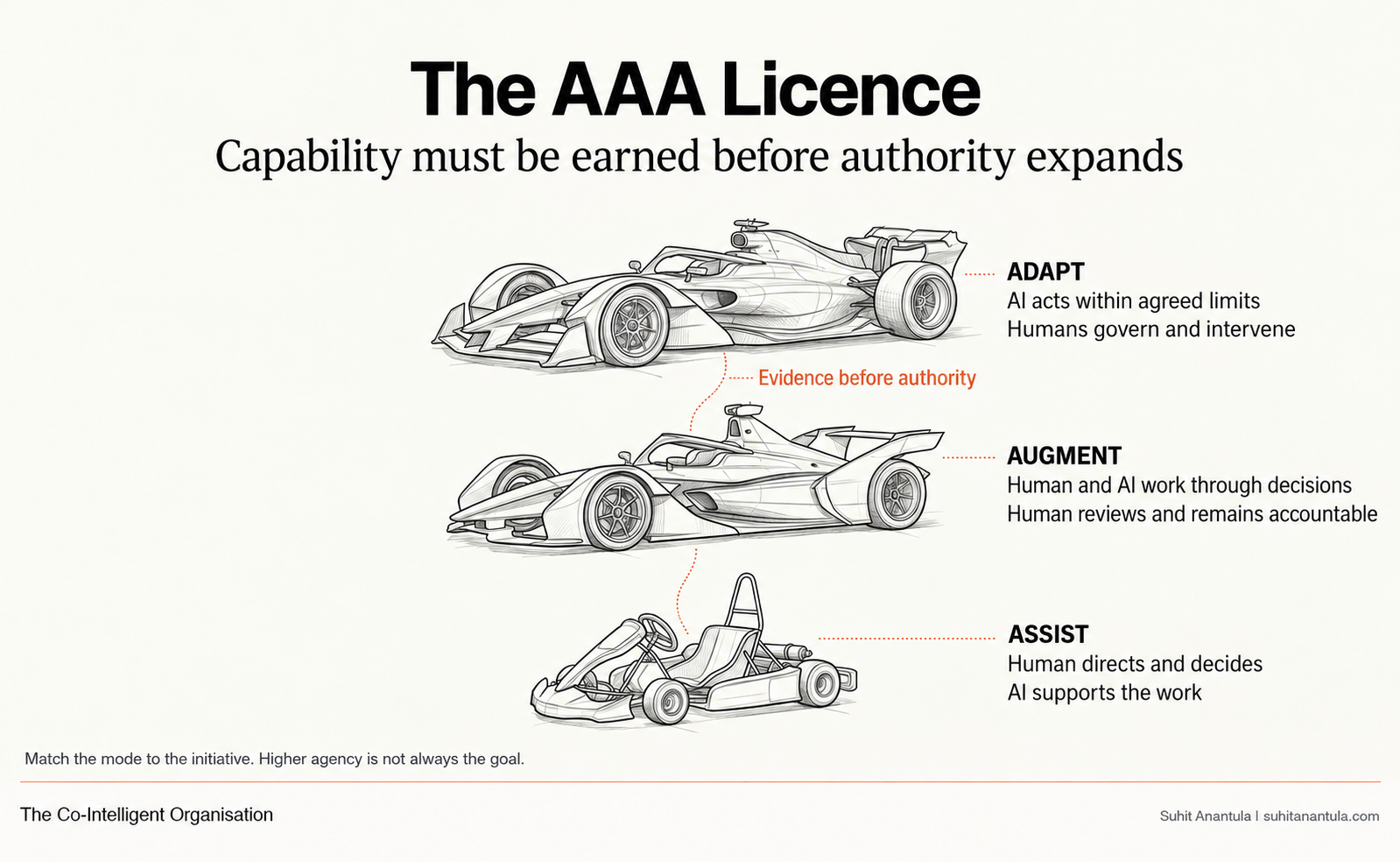
You cannot buy an ADAPT licence with ASSIST maturity.
These are agency modes. They do not tell you whether a task is low-risk, customer-facing, or mission-critical. A safety-critical task may need to remain human-led.
Red Bull offers a useful picture of the relationship between modelling and human judgement. Its strategy team runs simulations and turns the results into race decisions with the engineers on the pit wall. That public account supports the partnership analogy. It does not establish a separate AAA maturity rating for every internal process.
An organisation can use all three modes across its portfolio. The licence belongs to the initiative, its operating conditions, and the people responsible for it.
The Williams Paradox
When James Vowles became Team Principal of Williams Racing in 2023, he set about rebuilding the team's foundations.
By August 2024, Formula 1 reported that the work included moving away from Microsoft Excel to manage the car build. Vowles described gaps in basic knowledge: how long a front wing would take to build and where it was in the system. Those gaps mattered across a car made of thousands of parts.
His priority was dependable data, processes and infrastructure before the next wave of performance investment.
Vowles understood the ladder.
The organisational analogy is straightforward. Reliable records and accountable processes make more ambitious systems possible. A new model cannot compensate for not knowing where the parts are.
That is the foundation the AAA Licence asks you to inspect.
The Ferrari Gap
Ferrari's 2024 car offers a narrower lesson about the distance between a model and its operating environment.
An upgrade introduced in Barcelona brought a bouncing problem. Formula 1's technical account described how the later Monza floor addressed it. More promising hardware did not automatically produce the intended performance on every circuit.
The AI parallel is an interpretation, not an assessment of Ferrari's internal AI governance.
An organisation can buy a sophisticated system and still lack the feedback, operating knowledge or controls needed to use it well. I call that mismatch the Ferrari Gap:
The authority a system is given exceeds the capability to govern it.
A position on the 9Q Grid describes work and agency. It does not certify the organisation's readiness to operate there. An initiative belongs in ADAPT only when the organisation can support its delegated authority in that context.
The Klarna Lesson
In February 2024, Klarna said its AI assistant was doing work equivalent to 700 full-time customer-service agents. That is a claim about workload. It is not evidence that 700 people were dismissed because of that assistant.
Klarna's 2025 filing described a dual approach: continued AI use alongside high-quality human support. It reported that the assistant handled 69% of customer-service chats in the twelve months to June 2025.
The useful question is what happens to the cases the system cannot resolve. How does a customer reach a person? Who notices when a fast answer leaves the problem unsolved?
Efficiency does not, by itself, establish readiness for more delegated authority.
This is a governance question for each customer-service deployment. Public reporting does not establish that Klarna had no feedback loops, no governance, or no fallback.
It Wasn't Just Klarna
In August 2025, Commonwealth Bank reversed a decision affecting 45 direct-banking roles. The Finance Sector Union had disputed the bank's claims about reduced call volumes. CBA apologised and described the role cuts as an error.
That reversal is evidence that the staffing decision needed to be revisited. It does not establish a maturity score for the bank as a whole.
The Gartner Warning
In June 2025, Gartner predicted that half of the organisations expecting significant AI-driven reductions in customer-service staffing would abandon those plans by 2027. That was a forecast, not a finding that half had already reversed course.
The lesson is to test the operating model before committing to the staffing assumptions. Measure resolution, escalation and service quality as well as speed and cost.
Compare the Initiative with Its Licence
The 9Q Grid gives you the position. The AAA Licence asks whether you can support the agency at that position.
Keep those questions separate. Q1 to Q9 are cell labels, not a numerical readiness scale. Q7 is ASSIST in complex work. Q3 is ADAPT in structured work. A higher Q number does not automatically mean more delegated authority.
For each initiative, write down its work context, its agency mode and the evidence that supports that mode.
| Initiative | Position | Evidence needed for its licence |
|---|---|---|
| Structured decision support | Q2 Tactician, AUGMENT | People can review, challenge and override recommendations |
| Dynamic analysis with AI | Q5 Partner, AUGMENT | The team can test assumptions and improve the work through feedback |
| Signal interpretation in uncertainty | Q7 Navigator, ASSIST | People retain direction and decisions while assessing uncertain signals |
| Automated structured processing | Q3 Automator, ADAPT | Delegation has explicit limits, monitoring, exception handling and a safe fallback |
This is a practical readiness comparison. It is not a validated numerical index or a certificate that deployment is safe.
An initiative is over-extended when its actual authority exceeds the evidence supporting it. The answer may be to narrow its mandate, strengthen its controls, or keep a person in the decision until the evidence changes.
Do not average that mismatch away. A well-governed assistant elsewhere in the portfolio does not make an unsupported autonomous action safe.
The Three Diagnosis Patterns
The comparison makes three patterns visible:
| Pattern | What you see | What to do next |
|---|---|---|
| Anchor | Work remains human-led even where evidence may support more useful partnership | Test a bounded AUGMENT use case where the work warrants it |
| Overreach | A system has more authority than its controls and demonstrated capability can support | Narrow its authority and build the missing evidence |
| Piastri | The initiative's authority matches what the team can demonstrate and govern | Keep learning; expand the mandate only when the work and evidence justify it |
Pattern 1: The Anchor
An organisation has adopted basic tools: search, summaries and drafting assistance. People still direct the work.
That may be exactly right for some tasks. It becomes an Anchor when habit prevents a useful, bounded partnership that the team could support.
Prescription: Choose a real decision where AUGMENT would help. Demonstrate that people can question the recommendations, give feedback and take responsibility for the outcome.
Pattern 2: The Overreach
An organisation delegates actions before it can explain the system's boundaries, handle exceptions, or restore a safe human process.
The issue can appear in Q3 as readily as Q9. Structured work still needs governed delegation.
Prescription: Reduce the mandate to what can be supported now. Build the missing capability before restoring authority.
Pattern 3: The Piastri
The team can show why the initiative has its current authority. People know who decides, how to intervene, and what evidence would justify a change.
That is the target in any cell, including one that should remain at ASSIST.
Prescription: Keep the authority and evidence matched. Climb when the work calls for it, rather than because the next rung exists.
The Depth Test
Here's a diagnostic you can run today.
For your most ambitious AI initiative, answer these questions:
ASSIST Maturity (Level 1)
- Can we describe exactly what the AI is doing in plain language?
- Do we have consistent data flows into and out of the system?
- Have we proven we can shut it down safely if something goes wrong?
AUGMENT Maturity (Level 2)
- Have we completed at least one full feedback cycle that improved the system?
- Do we have logged examples of humans overriding AI recommendations?
- Can we explain why the AI made a specific recommendation (not just what)?
ADAPT Maturity (Level 3)
- Has the system been tested through representative operating conditions, including exceptions and failures?
- Do we have clear governance parameters that the AI operates within?
- Can a team that didn't build this system operate it successfully?
Read the evidence by level.
Every answer needs an example or a record. Counted ticks do not grant a licence. A missing shutdown path, accountable owner or governance boundary cannot be offset by strengths elsewhere.
AUGMENT requires the ASSIST foundations as well as evidence of effective human review. ADAPT requires those foundations plus proven limits, exception handling and intervention for the delegated actions.
Use the unanswered questions to define what must change. The Readiness Gates in the next chapter make that progression more explicit.
Earn Your Super Licence
Oscar Piastri could have tried to skip F2. He had won F3 in his rookie year. He had the talent. He had the backing of Alpine's driver academy.
He didn't skip. He climbed.
And in 2025, when he was fighting for the World Championship, he didn't look like someone who was still learning F1. He looked like someone who had mastered F4, Formula Renault, F3, and F2—and was now applying all of that mastery to the pinnacle.
Max Verstappen is a once-in-a-generation exception. The later Super Licence system made entry more formal, while retaining a route for exceptional cases.
Your organisation is not Max Verstappen.
The ladder exists because most drivers—most organisations—need each rung. The capability built at ASSIST enables success at AUGMENT. The discipline forged at AUGMENT enables governance at ADAPT.
Don't stare at Q9 and assume it is where every initiative belongs.
Look at where you are. Look at your maturity. Close the gap.
Then earn the authority the work actually needs.
The Super Licence isn't bought. It's earned.
Sources and Method
The AAA Licence and the named diagnosis patterns are the author's practical framework. The F1 comparisons illustrate the argument; they do not establish measured AI maturity ratings for the teams.
- Piastri's progression: Formula 1's account of his junior career. His 2025 results: FIA season classifications.
- Licence requirements: the 2016 Super Licence system and FIA Appendix L, October 2024.
- Williams: Vowles on rebuilding the team's foundations, August 2024.
- Ferrari: Formula 1's technical account of the 2024 floor changes.
- Red Bull: the team's account of simulation and strategy decisions.
- Klarna: February 2024 company announcement and 2025 company filing.
- Commonwealth Bank: the union's August 2025 dispute and ABC's report of the bank's reversal and apology.
- Gartner: the June 2025 staffing forecast.
Next: Chapter 6, The Readiness Gates. What must you prove before giving a system more authority?
Chequered Flag03 takeaways
- Position is not readiness. Wanting to operate in a higher-agency cell does not mean you are qualified to do it.
- The gap is the risk. The Ferrari Gap appears when portfolio ambition outruns capability maturity.
- The ladder is the strategy. Build the capability the work requires before expanding authority.