The F1 Revolution
The one-second war — and why your org is still driving the 2021 car.
The One-Second War
Lap 49 of the 2021 Russian Grand Prix. Lando Norris is four laps away from his first-ever Formula 1 victory, his McLaren dancing on the edge of adhesion as he holds off the seven-time world champion, Lewis Hamilton.
But high above the Sochi Autodrome, a weather front is collapsing.
On the pit wall, the team's probabilistic models digest 1.1 million data points per second—Doppler radar vectors, tire degradation curves, and air density shifts—and resolve into a single, blinking command: Box.
The machine knows, with near-mathematical certainty, that the track will become un-drivable in ninety seconds.
But inside the cockpit, the human sensor network disagrees. Norris feels the grip in his fingertips; he sees a dry racing line. When his engineer urges him to pit, the adrenaline-fueled pilot overrides the digital forecast with a scream of defiance: "NO!"
One second behind him, Lewis Hamilton faces the exact same choice. He, too, feels the grip holding. He, too, wants to brave the elements. But when the Mercedes algorithm insists, Hamilton suppresses his instinct, trusts the invisible data, and dives into the pits.
For sixty agonizing seconds, the two drivers exist in parallel realities—one betting on the biological "now," the other on the digital "next."
Then, the heavens open.
Norris is helpless, his car turning into a toboggan on the ice-like surface as he slides off the track, watching his maiden win evaporate in the spray. Hamilton, on the correct tires, cruises past to take the victory.
In that tragic slide, the era of the solo hero ended. The era of the Co-Intelligent Organisation began.
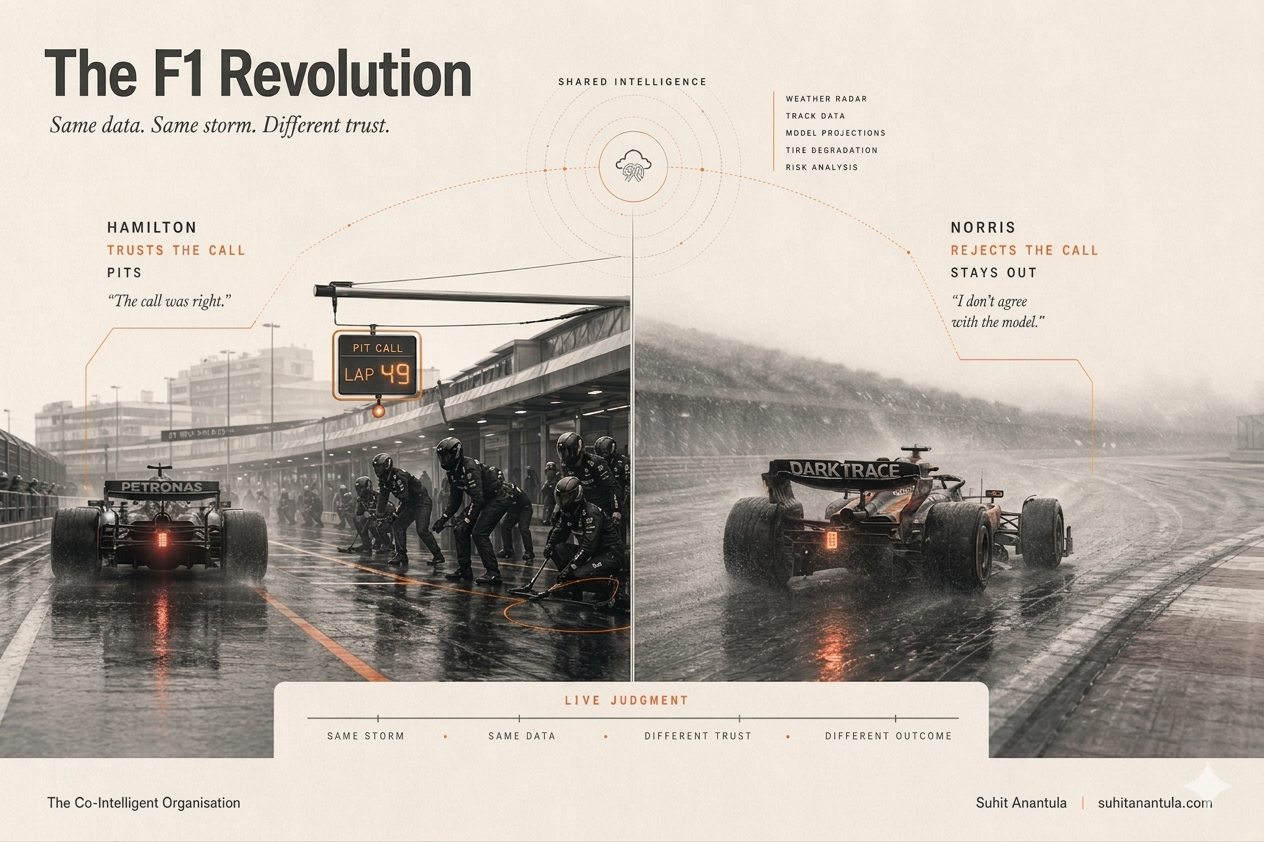
Hamilton had spent a decade building a relationship not just with his race engineer, but with the machine intelligence that backed him. He knew that when the "Box" command came with that level of urgency, the algorithm was seeing something his eyes couldn't. He had sufficient Trust Capital to override his own biological senses.
Norris, brilliant but younger, driving for a team still finding its championship form, trusted his hands more than his dashboard. He had the intelligence (the data said pit), but he lacked the trust to act on it.
This is the exact situation facing every CEO, every team leader, and every knowledge worker today.
Trust Capital is the override.
Intelligence without trust is useless. The data said pit; only one of the two drivers could act on it. The difference between Norris and Hamilton that afternoon wasn't talent, or the car. It was the quiet relationship between a pilot and a machine — years in the making, paid out in a single second.
The Day the Airflow Changed
In March 2022, something strange happened at pre-season testing in Bahrain.
Cars started bouncing.
Not the normal bumps of a racing car over kerbs. Violent, rhythmic oscillations that shook drivers in their seats at 200 miles per hour. Engineers watched in confusion as their multi-million dollar machines behaved like pogo sticks.
They called it "porpoising."
Formula 1 had just introduced the most significant regulation changes in nearly four decades. After 39 years of banning ground effect aerodynamics—the principle of generating downforce from airflow underneath the car—the sport brought it back.
Mercedes, who had dominated the previous eight seasons with a combined 15 World Championships, suddenly couldn't make their car work. Lewis Hamilton, fresh off losing the 2021 championship in the final lap of the final race, found himself driving a machine he described as "the worst thing I've ever felt in a racing car."
Red Bull understood something Mercedes didn't: when the rules change how air flows, you can't just modify your existing design. You have to start from first principles.
Their Chief Technical Officer, Adrian Newey—widely regarded as the greatest designer in Formula 1 history—had studied ground effect aerodynamics at university in the late 1970s. When F1 announced the return of ground effect, he reached into knowledge that had been dormant for decades.
The result was the RB18. While Mercedes tried to adapt their existing philosophy to new rules, Newey designed the suspension system himself—not as a component bolted onto the car, but as something intrinsic to the aerodynamics.
On the final day of testing, Red Bull appeared with a revised aerodynamic package that almost eliminated porpoising. Other teams were still trying to understand the problem. Red Bull had already solved it.
That season, Max Verstappen won 15 of 22 races—a new record.
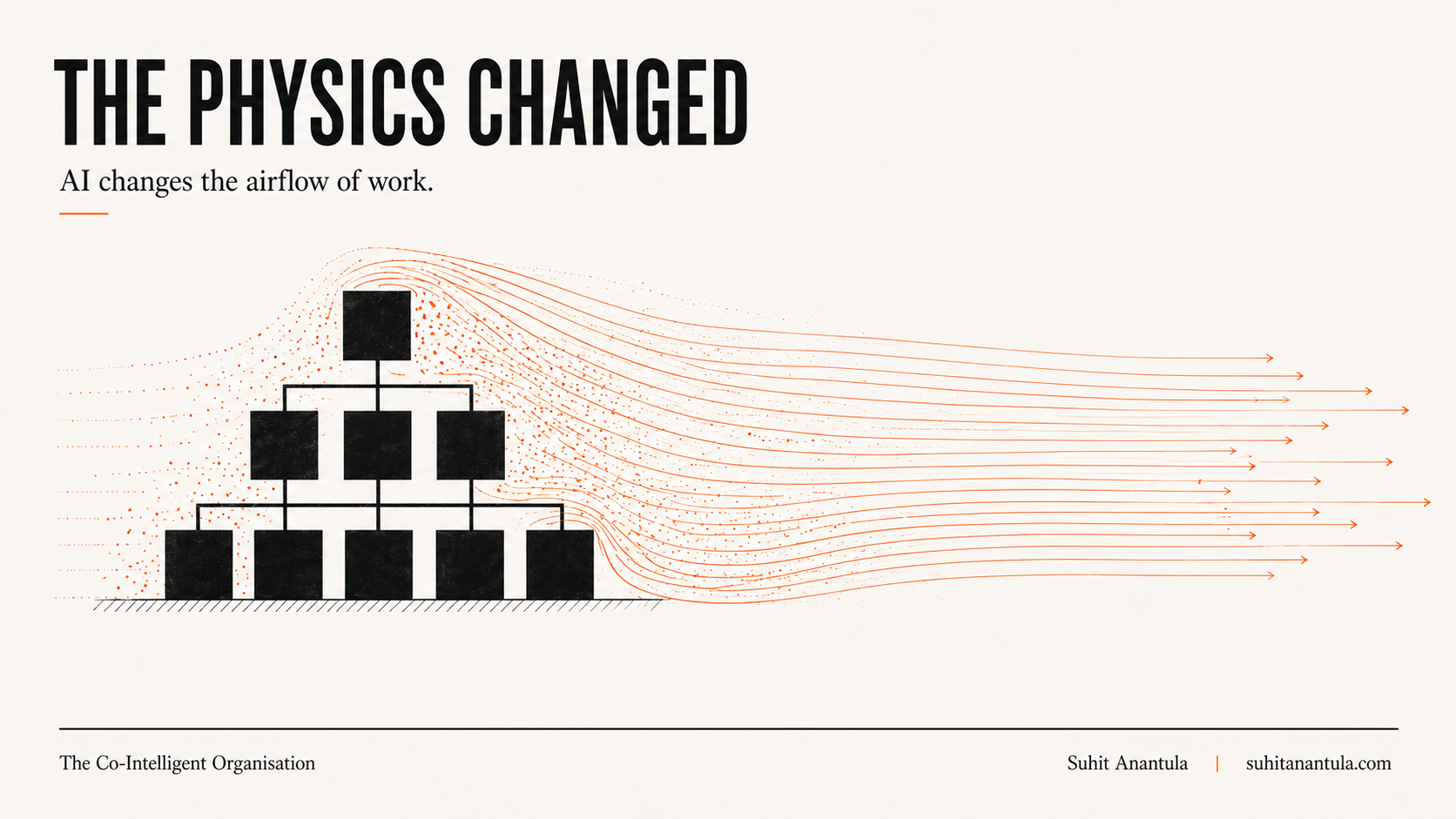
The physics changed. Red Bull changed their design to match. Mercedes tried to force old design into new physics. The results were predictable.
The Conductor on the Pit Wall
But here's what makes F1 truly remarkable: the machine is only part of the story.
Sit on the pit wall during a Grand Prix and you'll witness one of the most sophisticated human-AI collaboration systems ever created.
Hannah Schmitz doesn't drive. She doesn't touch the car. But she might be the most important person on Red Bull's team.
As Head of Race Strategy, Schmitz sits at a wall of monitors, watching data streams from thousands of sensors on Verstappen's car. Tire temperatures. Fuel loads. Gap to competitors. Weather radar. AI systems run millions of simulations in real-time, calculating the probability of different outcomes for every strategic decision.
Her job? Make race-winning decisions in under 30 seconds.
At the 2022 Monaco Grand Prix, Schmitz adapted the strategy brilliantly to a drying wet track—calling two stops that won Sergio Pérez the race. At the Hungarian Grand Prix, she orchestrated a strategy that took Verstappen from 10th on the grid to first across the finish line.
Christian Horner, Red Bull's team principal, calls her position "the linchpin" of the entire operation.
What makes Schmitz exceptional isn't that she ignores the AI. It's how she works with it.
"We're all very much a team. It's not always just about the numbers and the data. The drivers have a lot of feeling as well in the car... But at the end of the day, it's a strategy call, and we'll make the final call."
The AI says: "Pit now. 90% probability of success."
Schmitz feels something the algorithm can't quantify—maybe she notices clouds forming, or senses that the driver is in a rhythm.
"Stay out," she says.
That override—the human judgment layered on top of machine intelligence—is the essence of co-intelligence.
1.80 Seconds of Synchronization
While Schmitz orchestrates strategy, another team performs a different kind of miracle.
The world record for an F1 pit stop is 1.80 seconds. McLaren set it at the 2023 Qatar Grand Prix.
In 1.80 seconds, 20 people change four tires, each secured by a single wheel nut torqued to precise specifications. Three people work each tire: one removes the old wheel, one fits the new, one operates the wheel gun. Four more control the jacks. Others manage stabilization.
They don't communicate verbally during the stop. There's no time. They operate on pure protocol and signals, moving as a single organism.
The wheel guns they use are intelligent—sensing when a nut is secure, automatically switching direction from loosening to tightening. The guns are so violent that holding one incorrectly can break your wrist.
Here's the remarkable thing about that 1.80-second world record: it was not the product of adrenaline or improvisation. It was the residue of preparation, protocol, and trust.
They didn't communicate. They synchronized. They didn't collaborate. They performed as one.
This Is What's Happening to Your Industry
Let me tell you why I'm opening a business book with Formula 1.
Because the exact same thing is happening in your industry right now.
In 2022, the FIA changed the rules of how air flows around an F1 car. The organizations that redesigned from first principles dominated. The organizations that tried to adapt existing designs failed.
In November 2022, OpenAI released ChatGPT. The "physics" of business changed just as radically.
The rules changed. The airflow changed. The physics of your industry changed.
AI didn't just change the tools. It changed the physics of organisational work.
And just like Mercedes with their porpoising W13, most organizations are trying to bolt AI onto existing structures. They're treating ChatGPT like a faster typewriter. They're deploying copilots without changing workflows. They're building AI strategies on organizational foundations designed for a different era.
The results are predictable.
RAND finds that more than 80% of enterprise AI initiatives fail to deliver their intended business value—roughly twice the failure rate of traditional IT projects. McKinsey reports that nearly two-thirds of organisations remain stuck in pilot mode, unable to scale AI across the enterprise. BCG's research confirms only a small single-digit percentage of companies are capturing material value from AI at scale.
The industry is porpoising.
80%+ of enterprise AI initiatives fail to deliver their intended value (RAND). Nearly two-thirds remain stuck in pilot mode (McKinsey). Only a small single-digit percentage capture material value at scale (BCG). They're trying to win the 2026 championship with a 2021 car.
They're trying to win the 2026 championship with a 2021 car.
The New Scarcity
Every era is defined by what's scarce.
In the industrial age, capital was scarce. The strategic question was: Where do we allocate cash?
By mid-century, labor became the constraint. The strategic question shifted: How do we organize workers?
Then came the knowledge economy. Human intelligence was the bottleneck. The "war for talent" began. Companies competed for cognitive workers—engineers, analysts, strategists.
Now the ground is shifting again.
In October 2025, Sam Altman announced OpenAI's vision:
"We're going to build 1 GW AI factories every week."
One gigawatt powers roughly 750,000 homes—enough for a mid-sized city. Every week.
Intelligence is becoming a commodity. The factories are being built. The marginal cost of cognitive work is plummeting toward zero. AI-native startups now generate over $3 million in revenue per employee—six times what even elite public software companies achieve.
And abundance creates a new problem.
When intelligence was scarce, the challenge was: How do we get more of it?
When intelligence is abundant, the challenge becomes: How do we deploy it responsibly?
An AI can now write code, draft contracts, analyze medical images, trade securities. The capability exists. But should we let it? Should we trust an AI to speak to our customers? To approve loans? To make hiring decisions?
The scarce resource isn't intelligence anymore. It's the trust required to deploy it.
Form Follows Flow
One more lesson from F1.
In 1896, the architect Louis Sullivan coined the phrase "form follows function." You don't design a pretty building and try to squeeze a hospital inside it. You understand the function—surgery, recovery, patient care—and design the form around it.
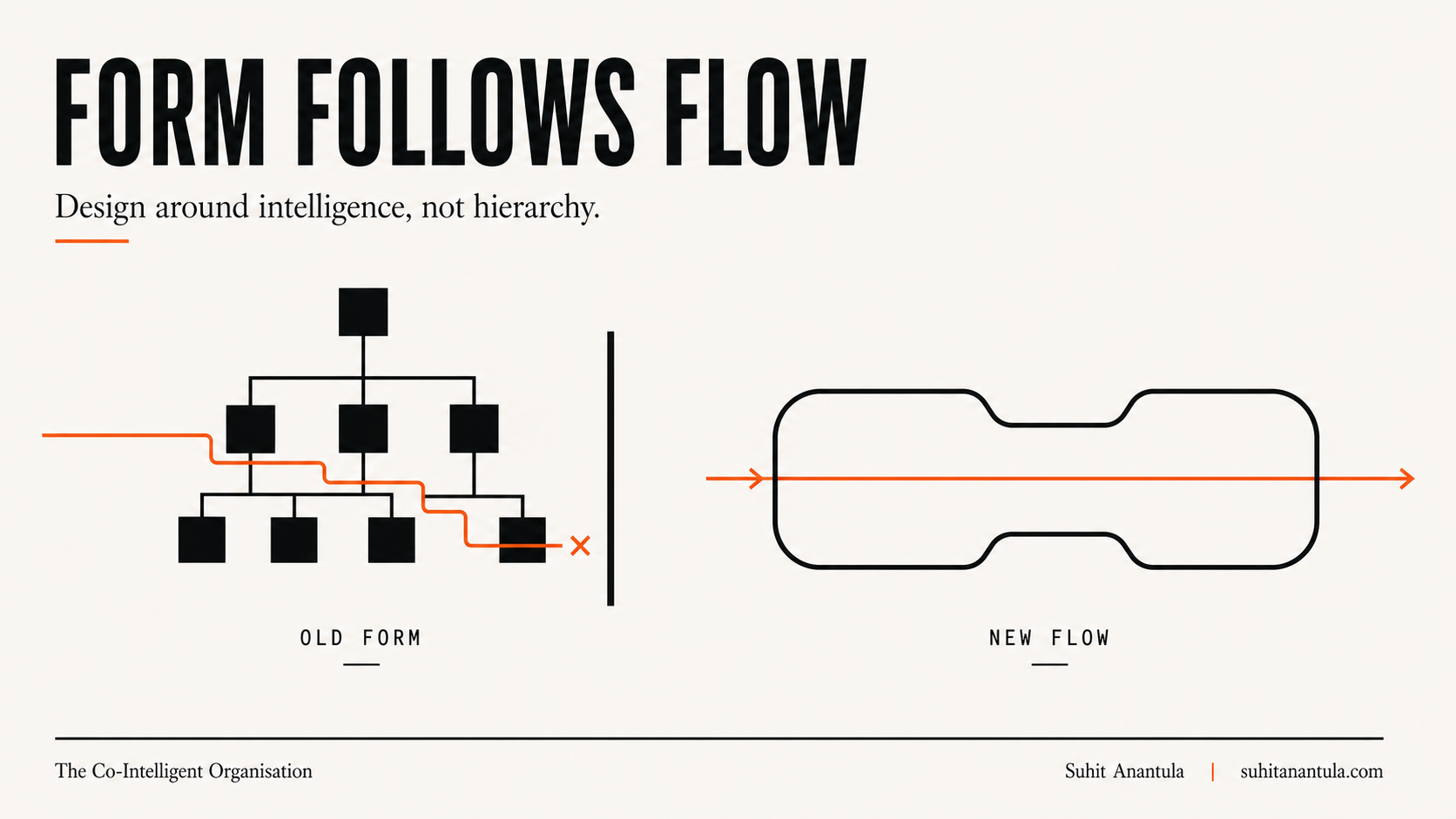
For the past century, business has operated on a corruption of this principle: form follows hierarchy.
We built the org chart first. The VP roles. The departments. Then we tried to force work to flow through those rigid boxes.
It worked when information moved at the speed of paper.
But AI is a high-speed fluid. Intelligence travels at the speed of light.
If you pour high-pressure, high-speed intelligence through a rigid, antique hierarchy, the pipes burst.
This is why the vast majority of AI transformations fail. They're running AI-speed workflows through bureaucratic-era structures.
The winning organizations understand a new principle: Form Follows Flow.
Design the flow first—the intelligent workflow, the human-AI collaboration pattern, the decision loop. Then build the form—the team structure, the governance model, the organizational container—to wrap around it.
Red Bull didn't start with their 2021 car and try to add ground effect. They started with the ground effect physics and designed a car that worked with it.
You can't bolt AI onto your existing organization and expect transformation. You have to redesign from first principles.
The Map, The Licence, The Machine, and The Race
This book will teach you to think like an F1 team.
Part 1: The Map (Strategy)
Before Red Bull designs a car, they study the regulations. They understand the track. They know where they're racing.
The 9Q Grid gives you your map. It answers: Where should your AI portfolio be positioned? Not "how much AI do we have?" but "where should we be competing?"
Part 2: The Licence (Governance)
Even the best car can't race without a licence. The driver must qualify. The team must meet safety standards.
The Readiness Gates are your racing licence. They answer: Are you qualified to race at your target position?
Part 3: The Human and The Machine (Design)
Just as an F1 team designs an engine, crew, conductor, and chassis, you must design:
- The Engine: Your workflows, transformed through the 4A Method
- The Crew: Your teams, redesigned for human-AI collaboration
- The Conductor: Your leaders, evolved from doers to orchestrators
- The Container: Your structure, optimized for intelligence flow
Part 4: The Race (Execution)
Finally, you race. First, you build the infrastructure for safe experimentation—the Strategic Multiverse of branches, protected baselines, and merge rules. Then you run a 90-day season that turns those conditions into disciplined execution.
The Choice
The next 12 months will separate the field.
One group of companies will continue to treat AI as a "tool"—a faster typewriter, a better search engine. They will see incremental gains, but they will eventually slide off the track, baffled by the speed of the storm.
The other group will realize that the car has to be redesigned. They will stop asking "how do I use this tool?" and start asking "how do I build a machine that thinks with me?"
Red Bull won because Adrian Newey understood ground effect physics better than anyone else. You can win because you understand the physics of co-intelligence—human and AI working together, each amplifying the other.
Hannah Schmitz makes championship-winning decisions in 30 seconds because she has AI crunching millions of simulations AND the judgment to override when her intuition says otherwise.
A pit crew changes four tires in 1.80 seconds because they've designed their work—their form—around the flow of the task.
The Co-Intelligent Organisation isn't about having more AI. It's about designing your organization—your machine—so that human and artificial intelligence flow together without friction.
The rules have changed.
Will you redesign from first principles? Or will you spend 2026 porpoising?
The flag is down. The lights are out.
Welcome to the Co-Intelligent revolution.
Chequered Flag03 takeaways
The physics changed. AI is not a new tool inside the old organization; it changes the airflow of work itself.
Trust decides speed. Hamilton and Norris had access to the same intelligence. Only one had the relationship to act on it.
Form follows flow. The organizations that redesign from first principles will pull away from those still bolting AI onto old structures.