Preface
Why this book, why this shape, why now.
What does the future of an organisation look like when machine intelligence is abundant?
And what is the role of the human?
These are the questions guiding me. They came after I wrote The Helix Moment, which was about strategy, design, and AI. I had spent twenty years in strategy and design, and I wanted to understand how AI changes that work. The Helix Moment was my answer.
But then I came to the next question. It is not just strategy and design. It is the entire organisation. How do we change all of it?
Co-intelligence
The word that unlocked it for me was co-intelligence.
Ethan Mollick wrote a book by that name, and his argument struck me. We — humans — have to change. We have to learn how to work with AI, not against it, not under it, not around it. Mollick wrote at the individual level. The centaur. The cyborg. How I get smarter.
I came to it from the design side, where co-design has been part of how I work for years. Co-design taught me that you cannot design for people; you have to design with them. Co-intelligence read the same way to me. You cannot deploy AI at an organisation. You build something with it.
But organisations are not individuals. The question for a CEO is not "how do I use ChatGPT?" The question is: how do we redesign workflows, teams, structures, governance — for a world where intelligence is abundant?
We have learned how to be co-intelligent individuals.
Now we have to learn how to build co-intelligent collectives.
That is what this book is about.
What Drucker Did
Peter Drucker is the father of management. Anyone who has ever met me knows how much I have learned from him.
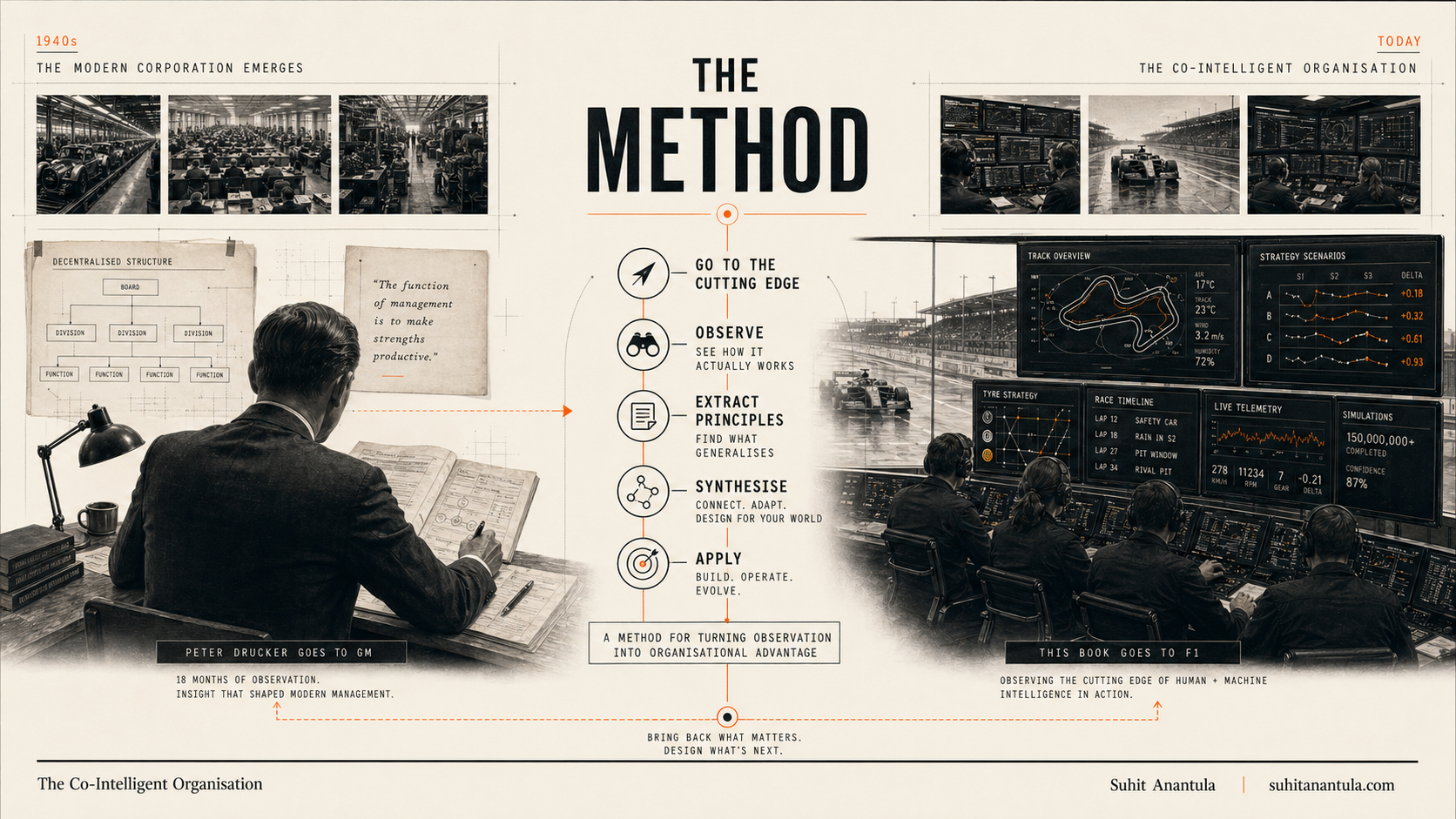
One of the reasons he is called the father of management is that, in the 1940s, Drucker went looking for the cutting edge of how organisations actually worked. At the time, the cutting edge was General Motors — the biggest corporation in the world, the first organisation built to scale a business at that level. Alfred Sloan invited Drucker, who was then a journalist writing on the big-picture dynamics of the world, to come inside.
Drucker spent eighteen months observing. The book that came out of it in 1946— Concept of the Corporation — became one of the first true management books. The ideas he extracted from GM (decentralisation, management by objectives, the knowledge worker) became the foundation of modern management thinking.
Drucker did not write a how-to book. He wrote an observation. He said: this is what a modern corporation looks like, these are the principles it operates by, this is what we can learn from it.
That story matters because it gave me the method: go and find the cutting edge. Not because the cutting edge explains everything. Not because understanding one organisation gives you insight into every other. But because it is useful. You can see something there that has not yet shown up everywhere else.
So I went looking. Where does a co-intelligent organisation actually sit? Where is one I can study?
Why Formula 1
Of all places, I found it in Formula 1.
Like a lot of people in the last few years, I joined the F1 craze through Netflix. But the more I watched, the more I dug deeper. The way these teams manage technology, data, AI — and more importantly the way they organise humans around it — started to feel like the laboratory I had been looking for.
The driver. The pit wall. The way they fuse human and machine decision-making. The amount of money being spent. The simulations. The governance structures.
And the partners. Look closer at Red Bull, McLaren, Mercedes, Ferrari, even Williams — and you will see Oracle, Microsoft, Google, AWS, Atlassian working alongside them. Not for branding. They are at the cutting edge of AI together because that is where it is being figured out at speed and at stakes.
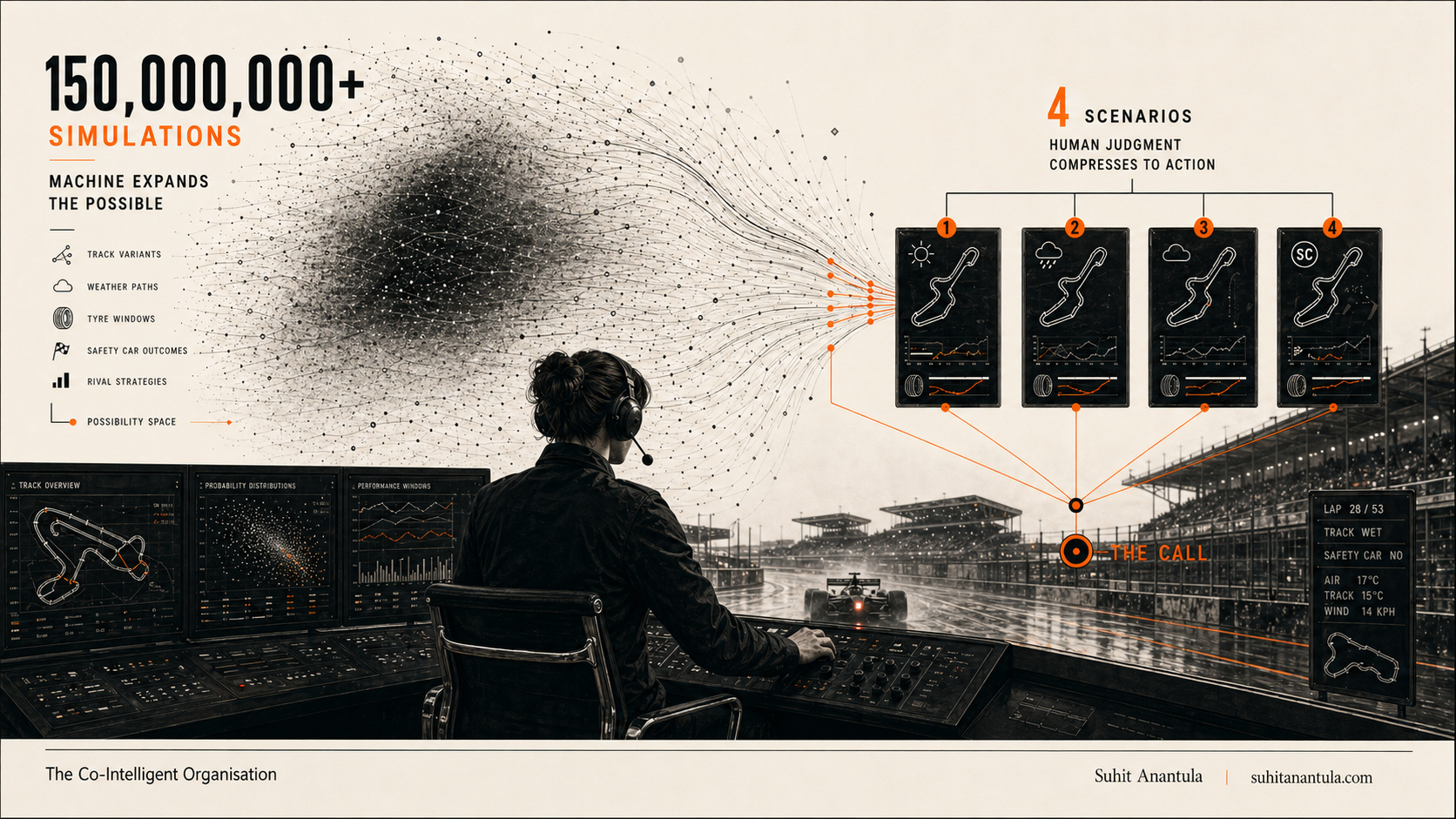
How do you take 150 million simulations and let a human still make the call?
How does Hannah Schmitz, Red Bull Racing's Head of Race Strategy — you will meet her properly later in the book — turn those 150 million simulations into the four scenarios her team and her driver can hold in their heads, and then change between them as the weather shifts, as another team plays a different game, as a safety car comes out?
That is co-intelligence at the organisational level. And it is happening now.
So I am taking a page from Drucker. Going deep into one place where the future is already running, and bringing back what I see — for businesses, for governments, for not-for-profits, for organisations of every shape.
The Four Layers
The book moves through four layers. They are the same four layers an F1 team works through, every season, every race.
The Map. Where does AI go in your organisation? You will be introduced to the 9Q Grid, which I believe is the strategy canvas for the co-intelligence era. It asks you the only two questions that actually matter: what is the role of the human, and what is the role of the machine.
The Licence. No F1 driver gets near a car until they have moved through F4, F3, F2, F1 — the FIA licence path. We need the same for AI. The licence is governance. The licence is what earns you the right to operate at higher levels of autonomy. Trust is the single biggest challenge in building AI-driven approaches, and trust does not come for free. You earn it.
The Human and The Machine. How do human and AI actually work together — not just technologically, but in the way the work itself is shaped? How does it all come together?
The Race. There is no point in any of this if you cannot win. You decide what winning means for you. But whatever it is, this is where it gets put in motion. How you set yourself up for the new future. How you change. How you adapt. How you work.
A Glimpse, Not a Map
I have to say this honestly: this is a small glimpse into a potential future. Most of it could be wrong.
But I had to write to understand. To learn. To figure out what this new frontier of organisational design can look like. In the process of writing, lots will change. What you read in chapter one and what you read in chapter twelve will not always agree, because I am thinking through this in the open.
This is not the future. This is a glimpse of it. A start.
The book is being written as a serial, online. It will always be free. You will be able to download a PDF. There will be a printed version when one is ready.
Follow the journey. Tell me where I am wrong. Tell me what I am missing. I would love to hear what you think.
— Suhit Anantula, Adelaide, Australia April, 2026
Organisation