The Helix Moment
The Helix: Strategy × Design in Motion
The Helix Model – Designing Strategy as a Living System
Design becomes strategic through curation, decision, and evaluation.
Strategy becomes designerly through empathy, system mapping, and iterative rules.
— Suhit Anantula
This isn’t just a clever turn of phrase.
It’s the crux of what’s broken — and what needs to be rebuilt — in how we design strategy in fast-moving, complex environments.
Most organisations still treat strategy as a one-time event:
A deck. A deadline. A decision frozen in time.
But today’s world won’t stand still.
From AI acceleration to climate breakdowns, demographic transitions to economic shocks — we need more than roadmaps.
We need something alive.
What if strategy wasn’t just a static product — but an evolving craft?
What if we blended the coherence of strategic thinking with the empathy, experimentation, and learning of design?
That's what the Helix Moment offers.
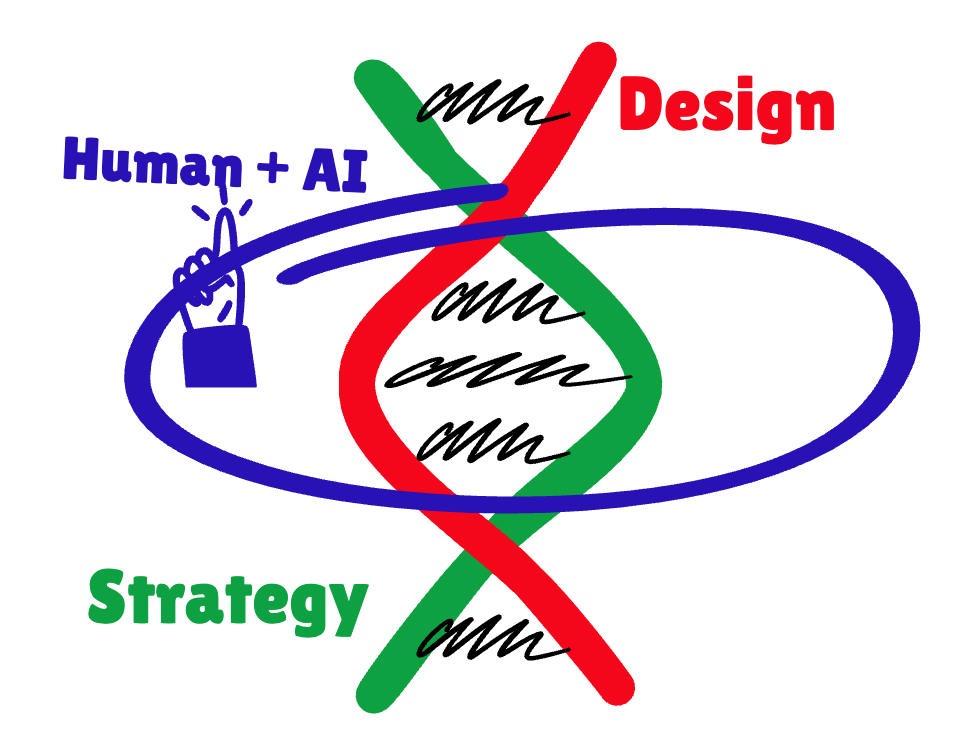
The Helix Metaphor
Picture a strand of DNA.
Two strands spiralling upward. Twisting. Intertwined.
That’s the essence of the Helix: two dynamic capabilities — Strategy and Design — woven together.
- Strategy is your logic, direction, focus, and choice.
- Design is your empathy, experimentation, and creative learning. Where these two touch — on every rung — is where the real value is created: insight meets action, logic meets emotion, plans meet prototypes.
Strategy × Design × AI
The Helix lives inside a broader context: a world increasingly shaped by AI.
But AI isn’t one strand of the helix. It’s the environment it lives in.
It surrounds the work. Influences it. Enhances it.
In each phase of strategy and design:
- AI helps us sense: research, data, patterns
- AI helps us generate: options, interfaces, simulations
- AI helps us evaluate: impact, feedback, signals But AI doesn’t lead. It augments.
This is still human-first work. Our creativity. Our ethics. Our intuition.
What Makes the Helix Powerful
- It’s integrated – not strategy vs design, but strategy with design
- It’s adaptive – not a fixed path, but a responsive system
- It’s rhythmic – moves in lines, loops, and vibes depending on context
- It’s AI-enhanced – uses intelligence to amplify insight, not automate thinking The Helix works because humans operate in all three modes: ▲ structured thinking, ● experimental learning, 〰 intuitive sensing.
Applying the Helix
Let’s take three sectors:
Tech / Product Design
▲ Strategy = product vision, market entry, commercial model
● Design = experience flows, usability, UX tests 〰 AI = code suggestion, personalisation, real-time feedback
Healthcare
Strategy = patient flow, system planning, resource allocation
Design = touchpoint experience, space, empathy in service
AI = diagnostics, treatment recommendations, optimisation
Education
Strategy = curriculum, model of delivery, growth strategy
Design = pedagogy, engagement models, learning environments
AI = adaptive learning, student analytics, feedback loops
A System That Moves
The Helix doesn’t replace existing methods.
It holds them. Enhances them. Moves them.
It’s not a rigid framework. It’s a choreography — a way of building strategy and design with pulse and flow.
The world moves.
Your strategy should too.
Talk to Helix Nexus
AI Thinking PartnerClick a prompt to copy it and open Nexus. Paste the question into the chat to get started.
Open Helix Nexus GPT