The Helix Moment
Face 4: The Hamster Wheel
Face 4: The Hamster Wheel - We're Stuck Reacting, Not Thinking Long-Term
Field Note: The Best-Kept Secret in Strategy
I think Peter Drucker’s Theory of the Business might be the best-kept secret in strategy.
For one, Drucker never called it a strategic framework.
So most people don’t realise it’s meant to shape strategy at all.
And second, Drucker didn’t write about business the way we often do today.
He didn’t use models or matrices.
He used systems thinking, philosophy, and deep observation.
But if you go back to his 1994 HBR article, it’s all there.
Drucker brought together three layers of strategic thinking: Context — what’s changing in the world, environment, or markets
Mission — what we believe we’re here to do, and what we think creates value
Strengths — what we’re good at, or in today’s language: our business models
Then he asked a simple question: What assumptions are we making about these three things?
Because every strategy is built on assumptions — about what’s true, what matters, and what works.
But those assumptions were made in a previous version of the world.
And the world moves.
So the power of Theory of the Business is that it holds the past, present, and future in conversation:
What was true when we created this?
What is true right now?
And what needs to be true about the world ahead for our strategy to still hold?
It’s not just a framework.
It’s a lens. A rhythm. A pause.
And in my experience, it’s one of the most powerful ways to explore strategy honestly — because it helps leaders see what they’re carrying, what’s still useful, and what’s ready to be let go.
"We're always busy. But are we actually going anywhere?"
It's one of the most common leadership pains:
Everyone's moving fast - putting out fires, launching experiments, hitting short-term KPIs.
But when you zoom out, there's no shared horizon.
"We keep reacting. We don't have time to think ahead."
This isn't just a capacity issue.
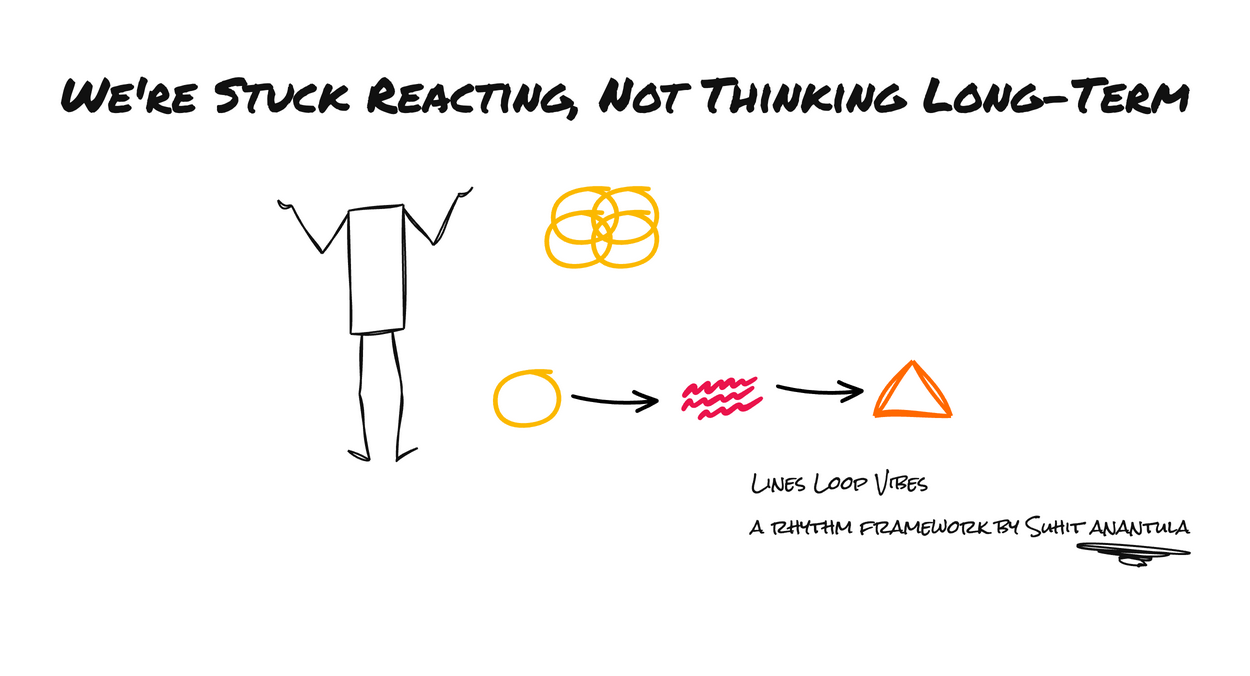
It's a 〰▲ futures intelligence issue.
When everything feels urgent, the future becomes abstract. And strategy becomes ● reactive survival instead of ▲ proactive direction.
Reframe the Rhythm
In 2007, Nokia held 40% of the global smartphone market. Their engineers had created the most reliable, durable phones in the world. But when the iPhone launched, Nokia's response was predictable: improve the camera, extend battery life, make better hardware.
By 2015, their smartphone market share was 1%.
This wasn't a failure of engineering. It was a failure of ●〰▲ rhythm intelligence.
This is a symptom of being stuck in ●●● reactive loops without 〰▲ strategic lift:
You're ● iterating well, but not 〰 sensing forward
You're ● making decisions, but not ▲ designing direction
This is a call to move from ●●● short-term reactive loops to 〰▲ long-term strategic direction - with rhythm intelligence.
Even in crisis, disciplined operating rhythms can create the space needed. During the 2008 financial crisis, Amazon maintained their long-term focus by continuing to invest in infrastructure and Prime membership while competitors cut costs, emerging stronger when conditions improved.
Domino's Pizza faced the same 2008 pressures as Amazon. While competitors cut costs, Domino's invested $40 million—60% of their 2007 profits—in digital infrastructure and completely overhauled their recipe.
The short-term pain was real: customers complained, sales initially dipped.
The long-term gain was extraordinary: stock price rose from $2.61 to over $160, with digital orders growing from 20% to 60% of total sales.
Two companies, same crisis, same strategic choice: maintain 〰▲ long-term rhythm intelligence despite ● short-term reactive pressure.
〰▲ Long-term thinking is not the opposite of ● speed.
It's what gives ● speed strategic ▲ meaning.
SAFE Activation: Futures (F) + Ambiguity (A)
When teams lose the future, it's often because:
They're overwhelmed by the present
They don't trust that plans will hold
They don't know how to work with uncertainty
SAFE says: strategy must start with 〰 imagination, not just ▲ planning.
It must move through 〰 fog, not just ▲ clarity.
Strategy Principle: Strategy is About the Future
Peter Drucker said: "The best way to predict the future is to create it."
But creating it requires time, vision, and space to think. Singapore institutionalised this principle by embedding the Centre for Strategic Futures within the Prime Minister's Office, using systematic foresight methodologies to help government think beyond electoral cycles.²
This principle reframes strategy as narrative foresight - the ability to:
Think beyond this quarter
Spot weak signals and long arcs
Ask what kind of world you're designing for
Framework: Theory of the Business (Peter Drucker)
Drucker's Theory of the Business asks a deceptively powerful question:
What must be true about your customers, your mission, and your environment for your strategy to make sense?
This framework helps leaders name the assumptions their strategy is built on: What are we assuming about our industry, market, and world?
What do we believe about our users or customers?
What do we think we're really good at - and will that still matter?
The power of this approach lies in its simplicity: If your assumptions are wrong, your strategy will eventually fail.
Netflix exemplifies this assumption-testing approach. When they shifted from DVD-by-mail to streaming, they didn't just launch a new service—they questioned fundamental assumptions about how people wanted to consume entertainment. Their willingness to cannibalize their profitable DVD business came from recognizing that their core assumption (convenience matters more than selection) was evolving.³
This makes it a foundational lens for 〰▲ future-oriented design:
It creates a 〰 diagnostic lens before committing to ▲ direction
It encourages 〰 slow clarity in a ● fast world
It gives teams a way to surface 〰 hidden truths and see what's changed
〰▲ Great strategy isn't built on ▲ predictions.
It's built on 〰 re-examining what you believe is true.
Foresight Across Rhythmic Modes
Different rhythmic modes play distinct roles in creating meaningful futures:
Lines Mode & Foresight
Creates structured horizons and clear time boundaries
Establishes vision-strategy-tactics hierarchies
Develops systematic roadmaps connecting present to future
Provides stability for long-term commitments
Loops Mode & Foresight
Tests assumptions through rapid experimentation
Refines future visions through feedback and learning
Creates adaptive pathways that respond to changing conditions
Builds future capabilities through progressive iteration
Vibes Mode & Foresight
Senses emerging patterns before they become obvious
Cultivates intuitive connection to possible futures
Creates resonant future narratives that inspire action
Attunes to cultural and emotional shifts that signal change
The foresight masters don't choose between these modes – they orchestrate them. They use lines to create clear horizons, loops to test assumptions and refine direction, and vibes to sense what might be emerging next.
Tools for Foresight Design
Once assumptions are surfaced, we can begin stretching imagination through foresight:
Visioning: Articulate a bold, preferred future
Backcasting: Reverse-engineer what needs to be true to reach it
Scenario Planning: Design "what if"s based on forces you don't control
Signal Scanning: Use qualitative + AI-augmented trend mapping to detect weak signals
These tools give structure to imagination - and rhythm to futures thinking.
Strategy that includes the future becomes a movement - not just a motion.
AI as Foresight Companion: From Reaction to Anticipation
AI transforms strategic foresight in three fundamental ways:
AI as Foresight Accelerant
Generate multiple future scenarios in minutes rather than weeks
Rapidly simulate potential outcomes across different time horizons
Process vast amounts of weak signals to identify emerging patterns
Automate trend analysis across industries, regions, and technologies
AI as Foresight Connector
Link current decisions to long-term implications through causal modeling
Connect weak signals across seemingly unrelated domains
Bridge operational metrics with strategic outcomes
Translate abstract futures into concrete strategic implications
Estée Lauder's AI transformation shows foresight acceleration in action. Their ConsumerIQ system analyses 80+ years of consumer data across 25 brands and 150 countries, while Trend Studio detects market shifts from social media and generates tailored responses.
The result: trend-to-market response time dropped from weeks to days.
This isn't AI replacing human judgment—it's AI amplifying human pattern recognition at impossible speed and scale.
AI as Foresight Amplifier
**Expand imaginative possibilities beyond organisational biases
Surface counterintuitive futures that challenge conventional thinking
Identify blind spots in organisational assumptions
Enhance scenario depth by modeling complex system interactions
The most powerful approaches combine human and machine foresight capabilities**: Humans define meaningful futures worth pursuing
AI expands the range of possible paths to those futures
Humans evaluate which paths align with values and purpose
AI helps identify potential obstacles and enablers along those paths
AI Prompting for Strategic Foresight
Effective prompts for future-oriented strategy include:
Signal Detection: "Analyse recent developments in [industry/domain] and identify 5 weak signals that could become significant trends in the next 3-5 years"
Assumption Testing: "What are 3 assumptions in our current strategy that might be challenged by emerging technologies, climate change, or demographic shifts?"
Scenario Generation: "Create 4 distinct future scenarios for our industry based on two critical uncertainties: [uncertainty 1] and [uncertainty 2]"
Future Backcasting: "If our vision for 2035 is [vision statement], what milestones would need to be achieved by 2030, 2028, and 2026?"
Strategy Stress-Testing: "How might our current strategic approach fail under each of these future scenarios? What would need to change to make it more resilient?"
Human-AI Collaboration Model for Strategic Foresight
Human-Led Purpose Setting
Humans articulate meaningful futures worth pursuing
Humans establish values that should guide future direction
Humans determine what success looks like across time horizons
AI-Augmented Exploration
AI identifies relevant weak signals and emerging patterns
AI generates diverse future scenarios and possibilities
AI simulates potential impacts of different strategic choices
Human-AI Collaborative Sense-Making
AI organises signals and scenarios into coherent narratives
Humans interpret meaning and implications through their context
Joint exploration of strategic options across time horizons
Human-Owned Direction Setting
Humans select which futures to prioritise based on values
Humans determine strategic commitments and resource allocation
Humans design implementation rhythms that connect present to future
Remember: AI excels at pattern detection and simulation, but humans must provide the meaning, values, and purpose that make futures worth pursuing.
Practice: Foresight Framing Sprint
Objective: Use imagination, design, and data to stretch beyond the short-term.
Agenda: Signals: What Nokia-level shifts are we missing in our industry? (30 min)
Apply Welch's test: If we weren't in this business, would we enter today?" (30 min)
Visioning: What would a 10-year bold success look like? (30 min)
Backcasting: What milestones would we need to hit? (30 min)
Scenarios: What are 3 alternate futures - good, neutral, risk? (30 min)
Strategy Fit: What would our current approach need to shift? (30 min)
AI Integration: Where could Estée Lauder-style pattern detection transform our sensing? (30 min)
Use AI to expand your imagination, not replace it.
Map where you are before designing where you want to go.
Final Reflection
What's your organisation's vision for the next decade?
How often do your teams actually talk about it?
What rhythm would help you connect the future to the now?
Nokia optimised hardware when they needed to sense software ecosystems.
Domino's invested in digital when competitors cut costs.
GE systematically abandoned businesses when others defended positions.
Estée Lauder accelerated trend detection when others relied on intuition.
The difference wasn't intelligence or resources.
It was rhythmic intelligence—knowing when to shift from Lines to Loops to Vibes, and back again.
References
Stone, B. (2013). The Everything Store: Jeff Bezos and the Age of Amazon. Little, Brown and Company.
Centre for Strategic Futures. (2024). About CSF. Singapore Government. https://www.csf.gov.sg/who-we-are/
Hastings, R., & Meyer, E. (2020). No Rules Rules: Netflix and the Culture of Reinvention. Penguin Press.
Welch, J., & Byrne, J. A. (2001). Jack: Straight from the Gut. Warner Books.
Drucker, P. F. (1994). The theory of the business. Harvard Business Review, 72(5), 95-104.
Vuori, T. O., & Huy, Q. N. (2016). Distributed attention and shared emotions in the innovation process: How Nokia lost the smartphone battle. Administrative Science Quarterly, 61(1), 9-51.
Research and Markets. (2016). Global Smartphone Market Share Analysis 2007-2016. Research and Markets Ltd.
Domino's Pizza Inc. (2009-2017). Annual Reports and SEC Filings. U.S. Securities and Exchange Commission.
Campaign Live. (2014). Case study: How Domino's and Crispin Porter & Bogusky transformed the pizza chain into a tech company. Campaign, November 15.
Microsoft News. (2023). Estée Lauder uses AI to reimagine trend forecasting and consumer marketing. Microsoft Corporation. https://news.microsoft.com/source/features/digital-transformation/estee-lauder-uses-ai-to-reimagine-trend-forecasting-and-consumer-marketing/
Blockchain News. (2023). Estée Lauder Partners with Microsoft to Revolutionize Trend Forecasting Using AI. Blockchain News, August 12.
World Economic Forum. (2023). Why corporate foresight matters according to research. WEF Stories, September 15. https://www.weforum.org/stories/2023/09/strategic-foresight-research-insights/
McKinsey & Company. (2024). How AI is transforming strategy development. McKinsey Insights, March 8.
IBM Institute for Business Value. (2024). Benchmarking the AI advantage in finance. IBM Corporation.
PwC. (2025). 2025 AI Business Predictions. PricewaterhouseCoopers LLP.
Talk to Helix Nexus
AI Thinking PartnerClick a prompt to copy it and open Nexus. Paste the question into the chat to get started.
Open Helix Nexus GPT