The Helix Moment
Kodak vs. Fujifilm
How two photography giants faced the same disruption with radically different rhythmic responses
Rhythm Mode: 〰 Vibes
Reader Objective: Learn to recognise rhythm intelligence in action and understand how organisational rhythm determines survival during disruption.
The Setup: Two Giants, One Disruption
In 1975, both Kodak and Fujifilm were photography powerhouses.
Both companies:
- Dominated their respective markets (US and Japan)
- Made massive profits from film chemistry
- Employed thousands of chemical engineers and researchers
- Had built business models around consumable film products Both companies faced the exact same disruption: digital photography.
Both companies had early access to digital technology.
But their 〰 rhythmic responses were completely different.
One company died. One company thrived.
The difference wasn't technology, strategy, or resources.
Our conjecture is that it was 〰 rhythm intelligence—the ability to sense when to change pace, when to hold steady, and when to completely transform.
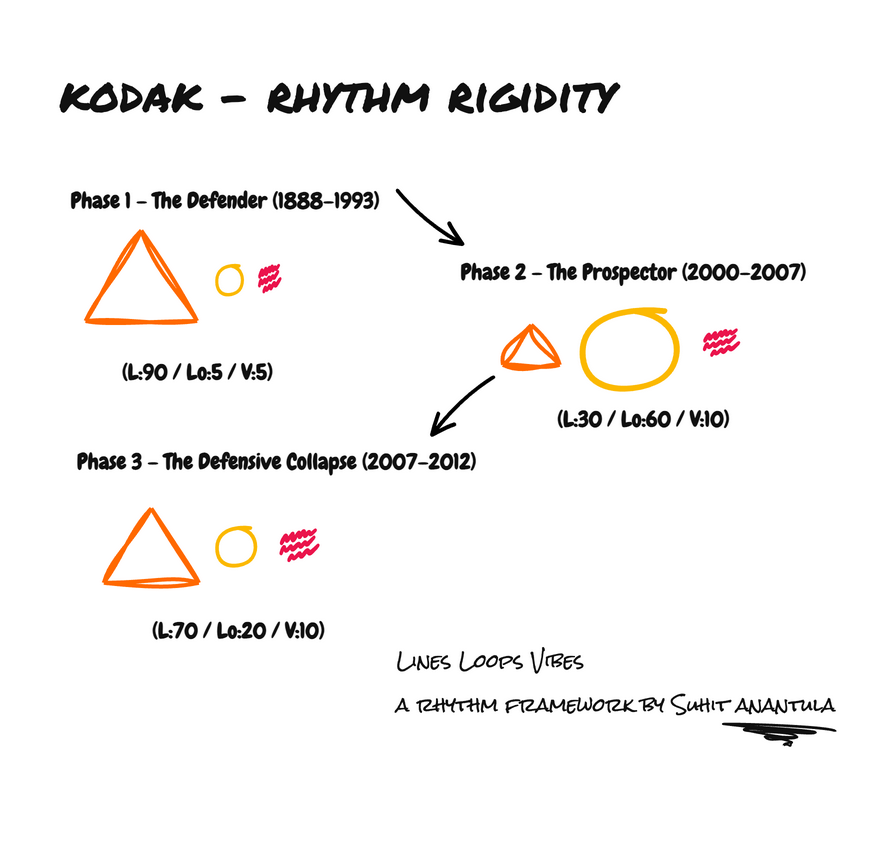
Kodak: Stuck in ▲ Lines Mode
The ▲ Lines Trap
Kodak approached digital disruption with ▲ Lines Mode thinking:
- Plan-Based Response: Extensive market analysis to determine "when" digital would become profitable
- Linear Protection: Focused on protecting existing film business as long as possible
- Systematic Resistance: Used patents and legal strategies to slow digital adoption
- Structural Thinking: Treated digital as a separate business unit rather than organisational transformation
Fatal Rhythm Patterns
Over-Analysis: Kodak spent years studying digital trends instead of experimenting with digital business models.
Protection Mode: Every strategic decision prioritised preserving film profits over building digital capabilities.
Sequential Thinking: Planned to transition from film to digital "when the time was right" rather than developing both simultaneously.
Cultural Rigidity: Maintained chemical engineering culture instead of developing software and digital capabilities.
The Result: Rhythm Paralysis
- Filed for bankruptcy in 2012 after 90% market share loss
- Lost $10+ billion in value during digital transition
- Laid off 90% of workforce (from 145,000 to 13,000 employees)
- Became business school case study of disruption failure Kodak couldn't shift rhythms when the environment demanded it.
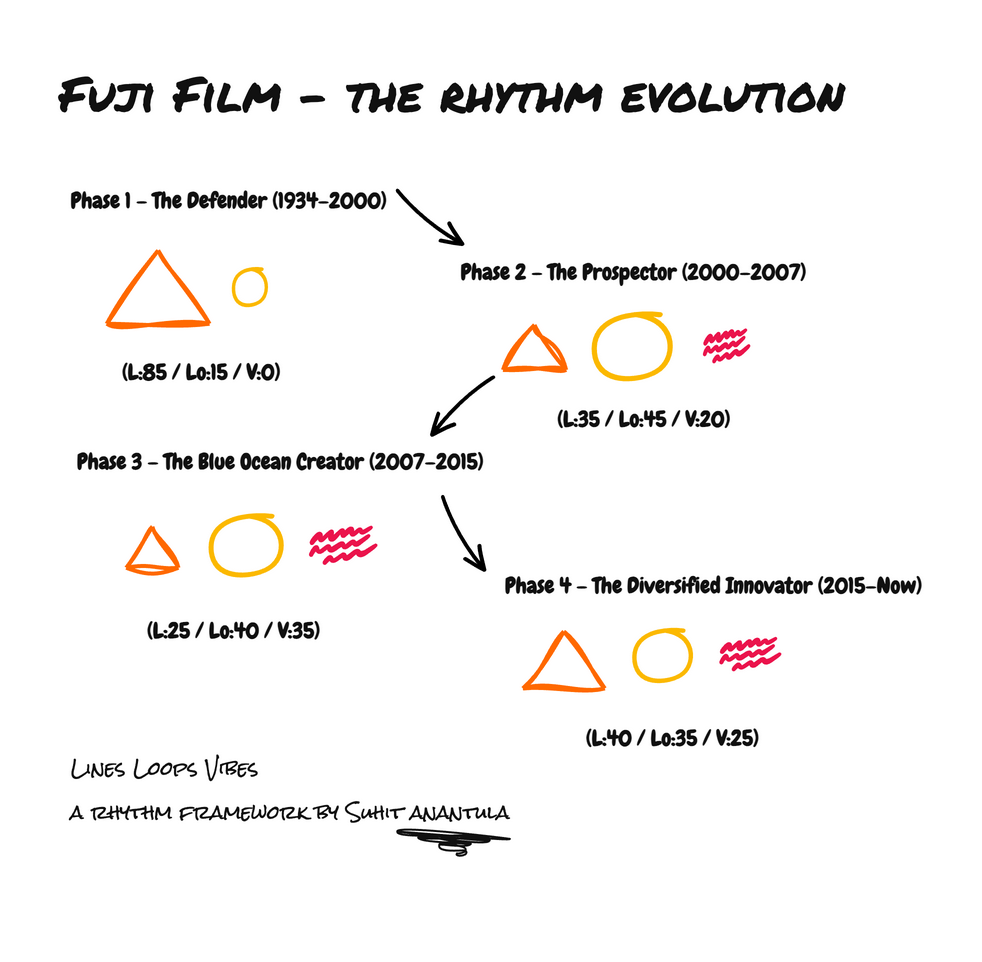
Fujifilm: ●〰▲ Multi-Rhythm Intelligence
The 〰 Sensing Shift
Fujifilm approached the same disruption with 〰 rhythm intelligence:
- 〰 Early Sensing: Recognised in the 1980s that digital would eventually disrupt film
- ● Portfolio Rhythm: Maintained film business while building new capabilities
- ● Experimental Culture: Ran multiple digital experiments without betting everything on one path
- 〰 Adaptive Leadership: Changed organisational culture while preserving valuable core capabilities
●〰▲ Multi-Rhythm Strategy
〰 Vibes Mode Sensing: Used intuition and cultural intelligence to sense timing of digital adoption across different markets.
● Loops Mode Innovation: Rapid experimentation with digital products, healthcare applications, and new business models.
▲ Lines Mode Execution: Systematic diversification into chemicals, healthcare, and digital imaging with operational excellence.
The Portfolio Transformation
Instead of just defending film, Fujifilm leveraged their core chemical expertise across new industries:
- Healthcare: Used chemical knowledge for pharmaceutical development
- Digital Imaging: Applied colour science to digital cameras and medical imaging
- Cosmetics: Leveraged chemical research for skincare products
- Document Solutions: Combined imaging with business process automation
The Result: Rhythmic Renaissance
- Maintained profitability throughout digital transition
- Diversified revenue streams across multiple growing industries
- Preserved employment while retraining workforce for new capabilities
- Built sustainable competitive advantages in healthcare and business solutions Fujifilm developed ●〰▲ multi-rhythm organisational intelligence.
The Rhythm Intelligence Analysis
What Kodak Missed
〰 Sensing Failure: Couldn't read environmental signals that demanded rhythm change
-
Over-indexed on financial analysis, under-indexed on cultural and technological momentum
-
Misread digital photography as "inferior quality" rather than "evolving capability"
-
Failed to sense emotional shift in customer relationship with photography Adaptation Failure: Stuck in single rhythm mode when multi-rhythm approach was needed
-
Tried to plan through disruption instead of experimenting through it
-
Protected assets instead of developing new capabilities
-
Sequential thinking instead of portfolio thinking Identity Failure: Defined themselves as "film company" rather than "imaging company"
-
Couldn't expand organisational identity to include digital capabilities
-
Cultural attachment to chemical engineering prevented software culture development
What Fujifilm Got Right
●〰▲ Multi-Domain Sensing: Read disruption across technical, cultural, and business dimensions
-
Tracked digital technology development AND cultural adoption patterns
-
Sensed geography-specific timing differences (digital adoption faster in US than Japan)
-
Understood disruption as system change, not just technology substitution ●〰▲ Rhythm Orchestration: Operated multiple rhythms simultaneously
-
▲ Lines: Maintained film business excellence during transition period
-
● Loops: Experimented with digital products and new business models
-
〰 Vibes: Sensed emerging opportunities in healthcare and cosmetics Identity Evolution: Redefined core capabilities rather than core products
-
Realised expertise was "chemical science" not "film manufacturing"
-
Built learning capability to enter new industries using existing knowledge
-
Maintained cultural strengths while developing new organisational capabilities
Rhythm Intelligence Principles
Principle 1: 〰 Sense Before You Plan
- Environmental sensing comes before strategic planning
- Cultural and emotional signals matter as much as technical and financial data
- Weak signals often matter more than strong current trends
Principle 2: ● Portfolio Over Protection
- Build new capabilities while maintaining existing strengths
- Diversify rhythm approaches across different business areas
- Create learning options rather than betting everything on single strategy
Principle 3: Identity Through Capability
- Define organisational identity through capabilities rather than products
- Maintain cultural strengths while developing new competencies
- Evolution over revolution when possible
Principle 4: ●〰▲ Multi-Rhythm Orchestration
- Different parts of business can operate in different rhythms simultaneously
- Coordinate timing across different business units and functions
- Integration through shared culture and capabilities rather than uniform approach
Modern Applications: Rhythm Intelligence Today
Netflix vs. Blockbuster
Same Pattern: Physical media to streaming disruption
Blockbuster (▲ Lines Mode): Protected store-based model, linear planning, sequential thinking
Netflix (●〰▲ Multi-Rhythm): Experimented with streaming while maintaining DVD business, portfolio approach, adaptive culture
Tesla vs. Traditional Auto
Same Pattern: Electric vehicle disruption
Traditional Auto (▲ Lines Mode): Protected internal combustion business, incremental electric initiatives, existing dealer networks
Tesla (●〰▲ Multi-Rhythm): Software-first culture, direct sales experimentation, complete system rethinking
Amazon vs. Traditional Retail
Same Pattern: E-commerce and cloud disruption
Traditional Retail (▲ Lines Mode): Protected physical stores, added online as separate channel, defensive thinking
Amazon (●〰▲ Multi-Rhythm): Built platform capabilities, experimented across industries, infrastructure as competitive advantage
Practice: Rhythm Intelligence Assessment
Objective: Develop your ability to recognise 〰 rhythm intelligence patterns and apply them to current disruptions.
Practice: Disruption Identification (15 min)
-
What disruption is your industry or organisation currently facing?
-
What are the "Kodak-like" and "Fujifilm-like" responses you see? Rhythm Pattern Analysis (25 min)
-
Which organisations in your space are stuck in single-rhythm responses?
-
Which organisations are demonstrating ●〰▲ multi-rhythm intelligence?
-
What 〰 sensing capabilities seem to distinguish the adaptive organisations? Capability Translation (20 min)
-
What are your organisation's core capabilities (like Fujifilm's chemical expertise)?
-
How might those capabilities apply to adjacent or emerging industries?
-
What new business models might leverage existing strengths? ●〰▲ Multi-Rhythm Strategy (20 min)
-
How might your organisation operate different rhythms simultaneously?
-
What experiments could you run while maintaining current business?
-
What 〰 sensing capabilities would help you read disruption signals better?
Reflection Questions
- Where do you see your organisation demonstrating 〰 rhythm intelligence vs. rhythm rigidity?
- What core capabilities might translate to new opportunities during current disruptions?
- How might you develop better 〰 sensing capacity for environmental rhythm changes?
- What would it look like to embrace disruption as rhythm evolution rather than threat? 〰 Rhythm intelligence isn't about predicting the future. It's about developing the sensing and adaptation capacity to move skillfully with whatever emerges.
The organisations that survive disruption aren't necessarily the ones with the best strategy.
They're the ones that can sense when the music is changing—and learn to dance to new rhythms while the old song is still playing.
That's not just business strategy. That's evolutionary intelligence. That's learning to thrive in a world where change is the only constant.
Talk to Helix Nexus
AI Thinking PartnerClick a prompt to copy it and open Nexus. Paste the question into the chat to get started.
Open Helix Nexus GPT