The Helix Moment
Collaborating with AI: Co-Intelligence
Collaborating with AI – Co-Intelligence
Let’s talk about the algorithm in the room.
We live in a moment where artificial intelligence has shifted from science fiction to daily utility. Strategy design without AI in 2025 feels like ignoring electricity in a modern city. It’s not optional. It’s ambient.
But this isn’t about hype. It’s about rhythm. And learning to co-create with a new kind of intelligence.
AI as a General Purpose Technology (GPT)
AI — particularly generative AI — is what economists call a general purpose technology, like electricity or the internet. It’s not a vertical tool. It’s a field of force.
You don’t use AI in one place — it shapes how you work, across everything.
Like the internet, AI’s most powerful use cases haven’t even been discovered yet. They’ll emerge through experimentation, reflection, and use. You don’t plan AI adoption — you learn your way into it.
AI is not a phase in the process. It’s part of the atmosphere.
The First Strategy Book Built for AI Leaders
This isn't a book about AI strategy. It's the first book about strategy in the age of AI. The Co-Intelligence Age.
In the Co-Intelligence age:
Planning horizons shrink from years to quarters to weeks
Competitive advantages emerge and disappear faster than ever
Human-AI collaboration creates new possibilities for strategic sensing
Organisations must learn and adapt at machine speed with human wisdom
This is strategy for leaders who refuse to be disrupted by AI—and instead want to lead with it.
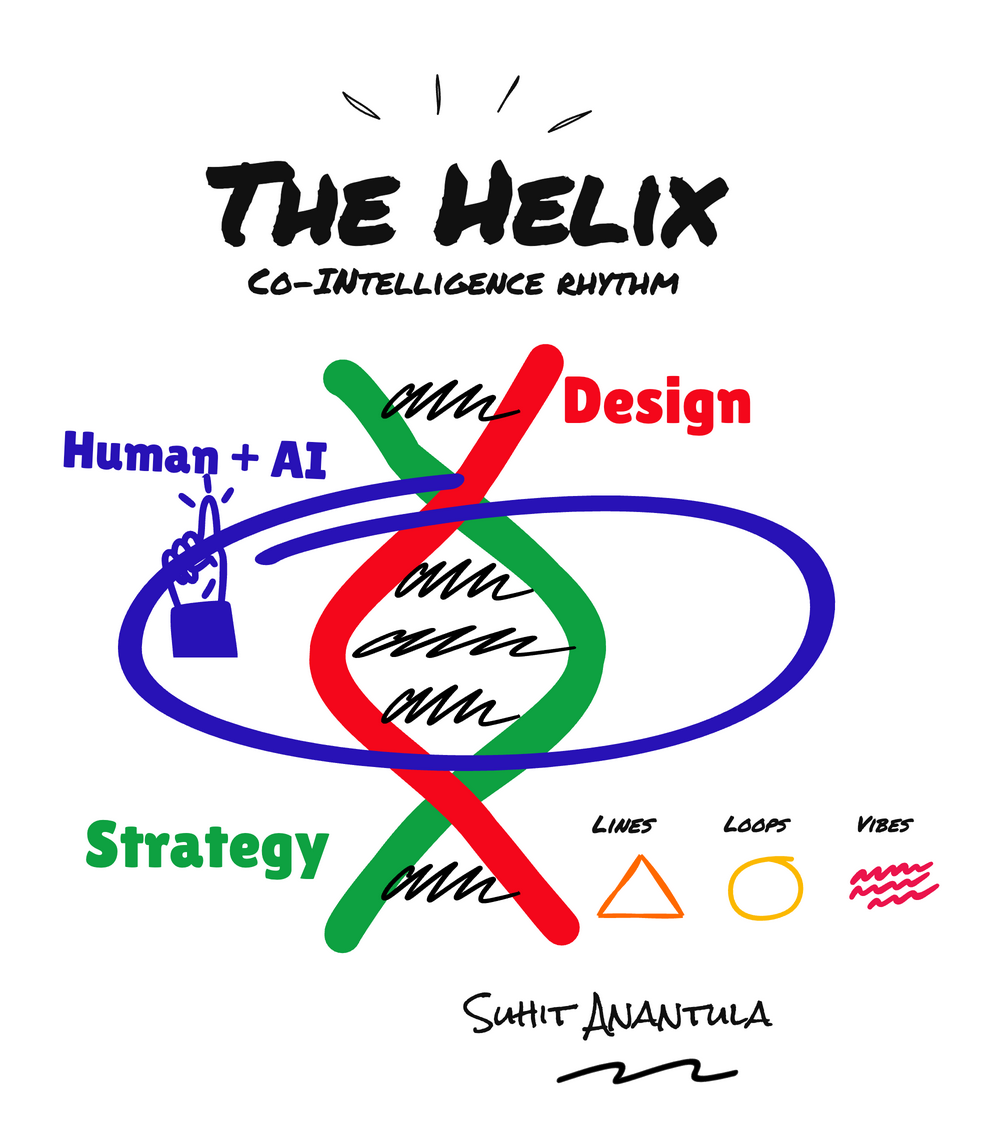
The Human + AI Rhythm
We use AI not to replace ourselves, but to amplify what we do best:
- Imagination
- Pattern recognition
- Judgment in context A useful mindset shift: The best strategy isn’t human vs AI. It’s human + AI, in rhythm.
This partnership works best when:
- Humans ask better questions (〰 intuition meets ▲ structure)
- AI generates options and analysis (● acceleration)
- Humans reflect, select, and steer (▲ judgement with 〰 wisdom)
Co-Intelligence: Two Rules We Follow
I’m inspired by Ethan Mollick’s book Co-Intelligence, which offers two elegant guidelines:
Always invite AI to the table – Use it in every part of the work. Ask what it sees. See what emerges.
Keep the human in the loop – Strategy is about ethics, emotion, and emergence. That’s still our domain.
How AI Shows Up in the Helix Moment
AI is not a third strand of the Helix. It’s the environment the Helix moves through.
It’s Co-Intelligence for strategy & design.
The AI-Human Handshake Points
In 5Ps of Loop Design (Introduced in Part 2 of the book) each "P" defines exactly where humans and AI interact: we define five zones of collaboration.
It’s not the work — but it accelerates the work.
Ethics, Bias, and Boundaries
AI is not neutral. It reflects our data, our decisions, and our limitations.
That’s why the Ethical–Emotional–Emergent (EEE) lens matters more than ever:
- Ethical: Are we designing responsibly?
- Emotional: Does this feel human, useful, and respectful?
- Emergent: What might evolve if we stay open? AI should not be treated as an oracle. It’s a collaborator — brilliant, fallible, and constantly learning.
Building Your Human + AI Edge
You don’t need to master AI. You need to partner with it.
Experiment. Prompt. Learn. Reflect.
Use AI to:
- Ask better questions
- Explore further faster
- Reduce friction
- Make space for more human connection AI isn’t the end of human creativity.
It’s the beginning of amplified imagination.
In the chapters that follow, we’ll meet the real-world friction: strategic pain points. AI won’t solve them — but it can help us listen, learn, and lead through them better.
From Structure to Iteration ●
"At some point, the plan gives way to the prototype."
Lines are where most of us begin. Strategy decks. Roadmaps. Frameworks. It feels safe — and often, it is.
But structure only takes us so far. Eventually, the world asks us to learn. To respond. To adjust.
This is the rhythm shift: from knowing to testing, from control to curiosity, from linearity to loops.
Where Lines give us direction, Loops give us discovery.
This next section is about practice: Designing your way through ambiguity
Moving in cycles, not just steps
Building learning systems, not just strategy systems
You'll meet the Iterative Design Rhythm, the SAFE Strategy posture, and real-world examples of navigating complexity through motion.
Before you go on, take a breath. Let go of the need to be right. You're stepping into a rhythm of becoming.
➤ Rhythm Trigger: The Moment of Misalignment
You sense it before you can explain it.
Teams are executing, but not evolving.
Plans are in motion, but not moving you forward.
The rhythm is off.
This is the moment you realise your organisation is out of sync—not broken, but unaligned. Not failing, but flat.
You’ve seen the patterns. You’ve named the shift. Now it’s time to move from knowing to making.
The next section invites you into movement: — to experiment,
— to prototype,
— to learn by doing.
Rhythm lives in Loops. Let’s begin.
—>
Talk to Helix Nexus
AI Thinking PartnerClick a prompt to copy it and open Nexus. Paste the question into the chat to get started.
Open Helix Nexus GPT