The Helix Moment
Face 5: The Whiplash
Face 5: The Whiplash - The World Is Changing Too Fast
"Every week, something new hits us - new tech, new competition, new mandates. We can't keep up."
This isn't just velocity. It's 〰 volatility.
The teams are trying to adapt, but everything's in flux. Markets shift. Tools change. Customer needs evolve mid-project. And the strategy? It's always six steps behind.
"By the time we agree on what to do, the world's already moved on."
This isn't a ● speed issue.
It's a 〰 resonance issue - and a 〰●▲ rhythm intelligence issue.
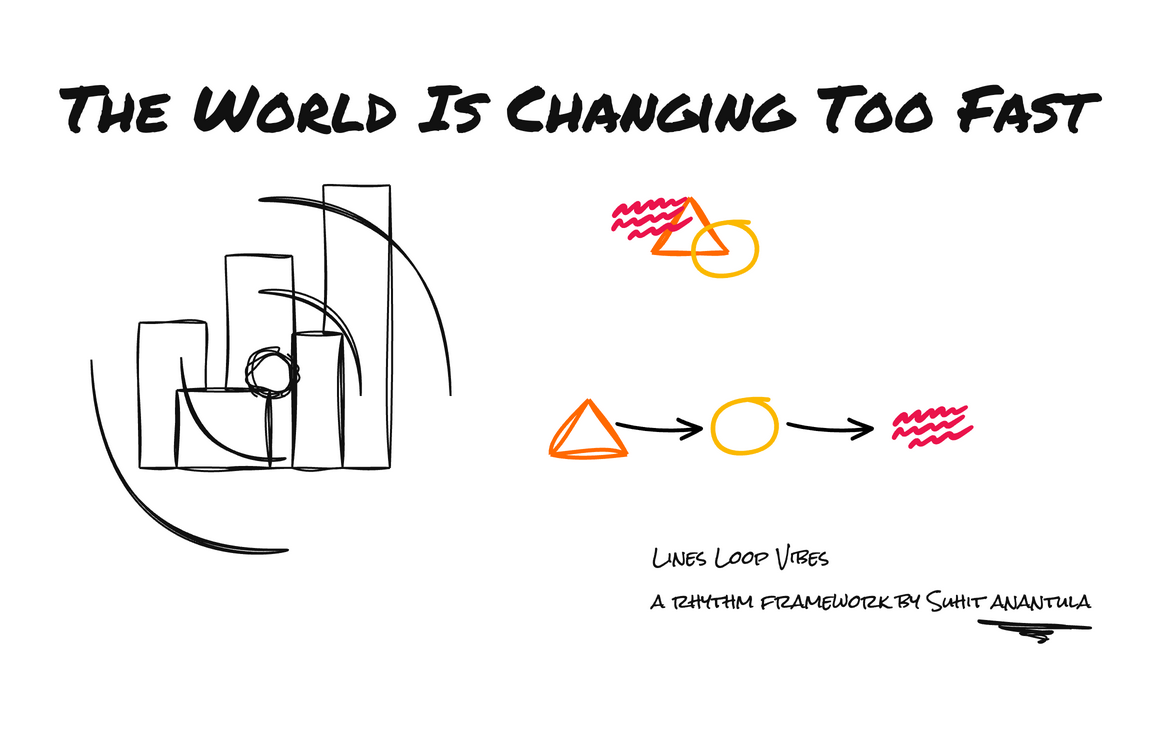
This visual at the start reveals everything.
That spiral? It's your organisation caught in the whirlwind of accelerating change. Every strategic plan, every carefully built system, every "best practice" getting swept up in forces moving faster than your decision cycles can handle.
But notice the path on the right.
The way through volatility isn't to fight the wind—it's to learn the rhythm of the storm itself. ▲ Lines give you structure to stay grounded. ● Loops help you adapt as conditions shift. 〰 Vibes let you sense the next gust before it hits.
Most organisations get trapped in the spiral because they're stuck in a single rhythm—usually ▲ Lines—trying to ▲ plan their way through chaos. The companies that thrive have learned something different: 〰●▲ rhythmic intelligence.
But here's what the evidence shows: Organisations implementing frameworks for rapid sensing and response report average performance improvements of 40-50%, while those failing to adapt have collectively lost over $100 billion in market value between 2020-2024.
Reframe the Rhythm
This pain point reveals itself when organisations are trapped between ▲ slow lines and 〰 chaotic vibes:
Plans are outdated the moment they're written (▲ Lines dysfunction)
Teams are moving fast but out of sync (〰 Vibes without coherence)
Sensing happens in isolation from decision-making (● Loops disconnection)
The result? Anxiety. Fatigue. Strategic whiplash.
What's needed isn't more ● speed - it's 〰 faster sensemaking and 〰●▲ rhythmic harmony.
Strategy must learn to move with reality, not around it.
Recent academic analysis of 249 empirical studies confirms this shift: companies with superior environmental sensing and decision velocity consistently outperform peers, with effect sizes of 0.3-0.6 indicating medium to large performance impacts.¹
SAFE Activation: Ambiguity (A) + Emergence (E)
This is a moment to: Accept that clarity is temporary (A)
Build the capacity to move through uncertainty (A)
Let strategy evolve through action, not declaration (E)
Create conditions for coherent responses to emerge (E)
When COVID hit in March 2020, Zoom faced 30x growth in 3 weeks. Rather than trying to control chaos, they embraced uncertainty, allowed their infrastructure strategy to emerge through action, and built the capacity to scale while maintaining quality. They didn't fight volatility—they moved with it.
But Zoom wasn't alone. Microsoft Teams scaled from 20 million to 75 million daily active users—a 275% growth in five months—by compressing feature deployment from quarterly releases to weekly updates. Netflix added 37 million subscribers versus 28 million the previous year by reducing content approval cycles from six months to 2-3 months.²
SAFE reminds us: you don't need to ▲ control the system - you need to 〰 sense it well and ●▲ respond wisely.
Field Note: The world is changing fast.
But if you asked Peter Drucker, he’d say it’s always been this way.
He’d take you back to 1890 — when electricity, automobiles, industrial chemistry, and new financial structures began transforming the modern world.
The disruption we live in today has deep roots.
But knowing that doesn’t make it easier to lead now.
Because the question isn’t if the world is changing.
It’s how we orient ourselves inside that change.
That’s why I love the OODA Loop, designed by military strategist and fighter pilot John Boyd.
Picture a Top Gun dogfight: two jets, each reacting and adapting in real time.
But instead of a jet, imagine your organisation, your project, your challenge.
You’re flying through turbulence.
Competitors are shifting.
Technology is rewriting the rules mid-air.
That’s what the OODA loop is for:
Observe – What’s happening, right now?
Orient – What’s your position, and what does it mean?
Decide – What’s the best next move?
Act – Move quickly, and learn fast
Then? You loop again.
It’s not just a military model.
It’s a mindset for strategy in fast, volatile systems.
I see it everywhere now: In cybersecurity, where the attack surface shifts by the hour
In AI, where a model release can render assumptions obsolete overnight
In geopolitics, where a sentence in a speech can reset an entire market
Sometimes, the world changes in a second.
And when it does — we don’t need a longer plan.
We need a tighter loop.
Strategy Principle: Strategy is Sensing Speed
● Speed doesn't mean rushing.
It means knowing 〰 when to act - and ● how fast.
This principle, inspired by Boyd's OODA Loop, reframes strategy as a 〰●▲ continuous feedback cycle:
〰 Observe – What's really happening? What's changed?
〰 Orient – What do we know? What patterns are emerging?
▲ Decide – What's the best move now?
● Act – Commit. Learn. Loop again.
In a fast-changing world, your ability to 〰●▲ re-orient is your advantage.
The organisation that can sense, interpret, and respond the fastest wins.
Framework: OODA Loop - From Military Strategy to Business Excellence
The OODA Loop offers more than just decision speed - it's a mindset of strategic agility that's now being explicitly adopted by leading organisations.
JPMorgan Chase CEO Jamie Dimon openly credits OODA loop principles for the bank's success during the 2023 regional banking crisis, achieving record profits of $43.74 billion in Q4 2024 - a 50% increase from the previous year. Dimon specifically describes running the $3.7 trillion institution through a "strategic process of constant review, analysis, decision making and action"—literally naming the OODA components.³
Observe: Stay in observation longer than your competitors
Develop multi-sensor awareness (data, intuition, network)
Create diverse input streams
Watch for pattern breaks, not just patterns
JPMorgan's AI implementation demonstrates this in practice: 20% reduction in fraud false positives, 95% reduction in anti-money laundering false positives, and compressing 360,000 annual hours of contract analysis to seconds. This isn't just efficiency—it's sensing speed multiplication.⁴
Orient: Integrate insights faster using diverse perspectives
Combine analytical and intuitive processing
Connect dots across domains
Challenge existing mental models
Decide: Build tight decision protocols
Match decision scope to certainty level
Distribute decision rights to appropriate levels
Balance speed with reversibility
Act: Move with precision and learning intent
Execute with clear measurement
Extract learning from each move
Feed insights back into observation
Walmart exemplifies OODA mastery at scale. During COVID-19, the retailer compressed inventory allocation decisions from weeks to days through real-time demand sensing linked to local COVID case data. By rapidly converting 2,400 stores into mini-fulfillment centres, Walmart became the only major retailer to generate net income growth in Q1 2020 despite $900 million in pandemic-related expenses.⁵
The goal isn't to outpace the world - it's to move in rhythm with it.
The Multi-Rhythm Response
Different rhythms play distinctive roles in volatility response:
Lines Mode: Creates the foundation
Structured sensing routines
Clear decision protocols
Reliable feedback systems
Consistent learning frameworks
Loops Mode: Drives adaptive response
Rapid experimentation cycles
Tight feedback loops
Regular pattern recognition
Continuous hypothesis testing
Vibes Mode: Reveals emergent possibilities
Intuitive pattern detection
Cultural and contextual sensing
Weak signal amplification
Novel connection making
ING Bank demonstrates sophisticated multi-rhythm orchestration. Their radical transformation into 350+ autonomous nine-person "squads" within 13 "tribes" maintains strict regulatory compliance frameworks (Lines) while enabling product iteration in 2-3 week cycles versus 10-16 weeks previously (Loops), all while fostering a culture where every employee spends time in customer service to maintain market sensing (Vibes). This orchestration improved their Net Promoter Score from -30 to +30 within one year.⁶
Organisations that master volatility don't choose one rhythm - they orchestrate all three in harmony.
The Cost of Slow Sensing: $100 Billion in Lessons
While successful companies demonstrate the value of rapid adaptation, failures reveal the devastating cost of rigid thinking:
Hertz's bankruptcy exemplified sensing failure compounded by structural rigidity. Revenue fell 73% year-over-year in April 2020, leading to Chapter 11 filing with $19 billion in debt. While competitors like Avis proactively restructured for the digital era, Hertz's complex securitized debt structure prevented crisis response flexibility.⁷
Peloton's collapse showed how companies mistake temporary trends for permanent shifts. Stock collapsed 96% from $170 to under $7 as management failed to distinguish pandemic-driven demand from sustainable growth. Net losses reached $2.83 billion in fiscal 2022, affecting thousands through multiple layoff rounds.⁸
JCPenney's decade-long decline accelerated catastrophically during COVID-19. Four CEOs in 10 years prevented coherent strategy, while early e-commerce success ($1 billion in 2006) atrophied through underinvestment. Filing bankruptcy with $4.5 billion in net losses, JCPenney's 85,000 employees paid the price for leadership's inability to sense and respond.⁹
The pattern is clear: sensing speed isn't optional—it's existential.
AI as Strategic Sensor
AI transforms strategic sensing in three fundamental ways - as accelerant, connector, and amplifier:
AI as Strategic Accelerant
Process thousands of market signals simultaneously, compressing analysis time
Continuously monitor competitor movements, technology developments, and customer behaviour shifts
Generate rapid scenario simulations based on emerging trends
Automate routine monitoring so humans can focus on novel patterns
AI as Strategic Connector
Link seemingly unrelated signals across different domains
Translate weak signals into strategic implications
Bridge organisational silos by routing relevant insights
Connect historical patterns with emerging trends
AI as Strategic Amplifier
Surface non-obvious patterns invisible to human analysis alone
Detect weak signals before they become obvious trends
Challenge team assumptions by highlighting counterintuitive data points
Generate multiple interpretations of the same signals
Walmart's AI-driven supply chain demonstrates enterprise-scale impact. Their Pactum AI system achieved a 68% success rate in automated supplier negotiations, reducing costs by 1.5%. The retailer's demand forecasting AI enables real-time simulation of disruption scenarios, automatically reallocating inventory across 4,700 stores. With over 50% of fulfillment centres already automated, Walmart has fundamentally transformed retail operations.¹⁰
Unilever's environmental AI applications show sensing extending beyond traditional business metrics. Using satellite imagery analysis for deforestation monitoring and machine learning for emissions optimization, the company achieved 82% reduction in surfactant production emissions while increasing retailer sales by 15-35% through AI-driven promotions.¹¹
The average return on investment for AI strategic intelligence implementations reached 3.7x, with top performers achieving up to 10.3x returns. Organisations report average deployment times of eight months with value realization within 13 months.¹²
The most powerful approaches combine AI sensing with human meaning-making. AI processes the landscape; humans provide context and judgment.
AI Prompting for Strategic Sensing
Enhanced Signal Detection Prompts: "Analyze these market data points and identify the 3-5 most significant anomalies that could signal strategic shifts, with confidence levels and potential impact assessment"
"Compare current customer feedback patterns with historical data to identify emerging dissatisfaction trends, then model potential business impact scenarios"
"Review competitor announcements from the past month and identify potential strategic pivots, including second-order effects on our market position"
Advanced Interpretation Prompts: "Generate three alternative explanations for this emerging trend, assess their strategic implications, and identify leading indicators that would validate each scenario"
"Model the second and third-order effects if this weak signal becomes a dominant market force, including impact on our competitive positioning"
"If this pattern continues, what strategic assumptions might we need to revisit, and what would be the cost of delayed response?"
Accelerated Response Prompts: "Suggest three potential 'no-regrets moves' we could make regardless of which scenario unfolds, with resource requirements and risk assessments"
"Design small experiments we could run in the next 30 days to test our hypotheses about this trend, including success metrics and learning objectives"
"Generate a comprehensive set of leading indicators that would tell us if our strategic response is working, with recommended monitoring frequencies"
Human-AI Collaboration Model for Strategic Sensing
AI-Augmented Signal Collection
AI monitors vast information streams continuously across news, social media, regulatory filings, and market data
AI identifies statistical anomalies and pattern breaks using machine learning algorithms
AI flags potential strategic signals for human attention with relevance scoring
Human-Led Sense-Making
Humans interpret signals within organisational context and strategic priorities
Humans apply strategic judgment and experience to assess implications
Humans connect signals to organisational capabilities and competitive constraints
AI-Enhanced Option Generation
AI generates multiple strategic response options with feasibility assessments
AI simulates potential outcomes of different approaches using scenario modeling
AI identifies resource requirements and implementation pathways
Human-Owned Decision Making
Humans select strategic responses based on values and organisational priorities
Humans commit organisational resources and attention
Humans take responsibility for strategic outcomes and stakeholder impacts
Combined Feedback Processing
AI tracks implementation results and environmental changes in real-time
Humans interpret lessons learned and strategic implications
Joint integration of insights into next sensing cycle for continuous improvement
Let AI speed up your sensing so you can slow down your thinking.
Practice: Enhanced Strategic OODA Sprint
Objective: Move from overwhelm to strategic clarity using short-loop decisions with AI amplification.
Agenda: Observe: Use AI + team insight to surface key signals (25 min)
What's changed in our environment this week? (AI monitoring dashboard review)
What patterns are our AI systems detecting? (Anomaly analysis)
What are our teams sensing that data might miss? (Human intuition synthesis)
What are competitors doing that we haven't noticed? (AI competitor tracking)
Orient: Make meaning of the signals (35 min)
What do these signals mean for our strategy? (Context application)
What assumptions might we need to update? (Belief challenging)
Where do we see opportunities or threats emerging? (Pattern recognition)
Which signals deserve immediate attention vs. longer-term monitoring?
Decide: Identify 2–3 specific responses (35 min)
What actions could we take in the next week? (Short-term moves)
Which decisions are reversible vs. irreversible? (Risk assessment)
How do we balance speed with thoughtfulness? (Decision velocity optimization)
What resources do we need to commit? (Implementation planning)
Act: Build tiny tests with AI support (25 min)
Design small experiments to test our hypotheses (Rapid prototyping)
Assign clear ownership and timelines (Accountability structure)
Establish success metrics and feedback loops (Learning systems)
Set up AI monitoring for early results detection (Continuous sensing)
Reflect: Assess what changed (25 min)
What did we learn from our actions? (Insight extraction)
How accurate were our initial interpretations? (Calibration check)
What should we watch for in the next cycle? (Forward sensing)
How can we improve our sensing-to-action speed? (Process optimization)
Loop: Schedule the next review cycle (15 min)
Set up automated AI alerts for key indicators
Assign responsibility for continuous monitoring
Plan deeper analysis for complex signals
Use AI for signal detection and option generation - but let humans drive meaning-making and decisions.
Final Reflection
What's one strategic decision you delayed because you were waiting for certainty?
What's one thing you could do tomorrow to learn faster?
What might you sense if you slowed down enough to really look?
The world is changing too fast.
But your organisation can move with it - if you build the rhythm to respond.
The evidence is overwhelming: companies implementing frameworks for rapid sensing and response achieve 40-50% performance improvements, while those clinging to traditional approaches face not merely competitive disadvantage but existential risk.
Sensing is speed.
Action is learning.
Loop early. Loop often.
The question is no longer whether to build strategic agility capabilities, but whether you can build them fast enough to survive accelerating change.
References
Nguyen, H., et al. (2024). The organisational impact of agility: a systematic literature review. Management Review Quarterly, 74(2), 447-491.
Netflix, Inc. (2021). 2020 Annual Report. https://ir.netflix.net/financials/annual-reports/default.aspx
Yahoo Finance. (2024, January 12). Jamie Dimon says he runs JPMorgan with a military tactic in mind named the 'OODA loop'— and it prevents the 'greatest mistakes' in war and business.
DigitalDefynd. (2025). 10 ways JP Morgan is using AI In Depth Case Study. https://digitaldefynd.com/IQ/jp-morgan-using-ai-case-study/
PYMNTS. (2024). Walmart: AI Helps Create 'Ready for Anything' Supply Chains. https://www.pymnts.com/supply-chain/2024/walmart-ai-helps-create-ready-for-anything-supply-chains/
McKinsey & Company. (2020). Agility in the time of COVID-19: Changing your operating model in an age of turbulence.
Reuters. (2020, May 22). Hertz files for U.S. bankruptcy protection as car rentals evaporate in pandemic.
CNBC. (2023, February 19). Inside Peloton's rapid rise and bitter fall — and its attempt at a comeback.
Reuters. (2020, May 8). Exclusive: J.C. Penney to file for bankruptcy as soon as next week, sources say.
CIO Dive. (2023). How Walmart enhances its inventory, supply chain through AI. https://www.ciodive.com/news/walmart-AI-ML-retail/638582/
AIX. (2024). Case Study: Unilever's Integration of AI in the Supply Chain. https://aiexpert.network/case-study-unilevers-integration-of-ai-in-the-supply-chain/
IBM. (2024, December 19). IBM Study: More Companies Turning to Open-Source AI Tools to Unlock ROI.
Talk to Helix Nexus
AI Thinking PartnerClick a prompt to copy it and open Nexus. Paste the question into the chat to get started.
Open Helix Nexus GPT