The Helix Moment
Face 2: The Beautiful Plan
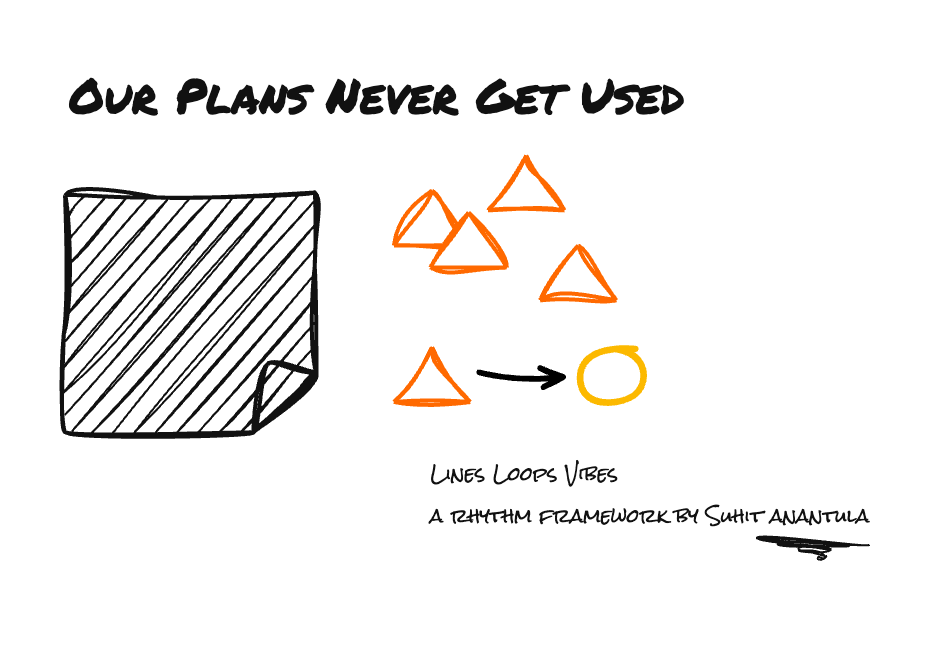
Face 2: The Beautiful Plan - Our Plans Never Get Used
The image looks familiar?
The beautiful strategic plan. Months of work. Perfectly logical. Board-approved.
Sitting unused while teams do what they've always done.
This isn't a failure of planning intelligence.
It's a failure of rhythmic intelligence.
Those scattered triangles? They represent every Lines-mode plan that ignored the Loops of reality.
The document gathering dust? That's what happens when strategy becomes a static artifact instead of a living system.
But notice that one triangle pointing to a circle...
That's where the magic happens. When rigid plans (Lines) transform into adaptive learning (Loops).
When strategy stops being a document and starts being a conversation with reality.
Let's start with the most expensive example of what happens when that conversation never occurs...
When Apple Genius Meets Retail Reality
Ron Johnson had the golden touch.
Apple retail genius. The architect of the Apple Store experience. The man who convinced people to stand in line for hours to buy a phone. Steve Jobs personally recruited him and later called him "the best retail executive in the world."
In 2011, JCPenney's desperate board offered Johnson $53 million to work the same magic on their struggling department stores.
Johnson's diagnosis was clear: JCPenney's constant sales and coupons were "drugs that customers needed to be weaned off." His solution was elegantly simple: "Fair and Square" pricing. No more sales. No more coupons. Everyday low prices, just like Apple.
The strategy looked brilliant on paper: Transform 1,100 stores into Apple Store-style boutiques
Attract younger, affluent demographics
Eliminate the "high-low" pricing that trained customers to wait for sales
Create premium experiences that justified premium margins
Johnson had transformed Apple retail from zero to $4 billion in annual revenue. His confidence was absolute.
The Fatal ▲ Lines Moment
When JCPenney's merchandising team suggested ● testing the new pricing model in a few stores first, Johnson's response became retail legend:
"We didn't test at Apple."
Instead of ● pilots, Johnson implemented ▲ sweeping structural changes across all 1,100 stores simultaneously. No ● gradual experimentation. No 〰 customer sensing loops. No ● adaptation based on early results.
He eliminated 590 of 600 sale events in the first year.
Customers had been programmed by decades of JCPenney sales to expect 40-70% discounts. Johnson's "fair" prices often ended up higher than what customers typically paid during promotions. But there was no sensing mechanism to discover this—and no learning loops to adjust.
Reality Strikes Back
The collision was immediate and devastating: Q1 2012: Same-store sales collapsed 20%—called "the worst quarter in retail history"
Annual 2012: Revenue dropped 25% to $13 billion
Customer traffic: Fell 10 million visitors per month
Stock price: Plummeted 50% in his first year
But Johnson stayed committed to ▲ rigid execution. No ● pivots. No ● testing. No 〰● adaptive sensing.
"I'm not going back," he declared, even as the losses mounted—trapped in ▲ structural thinking without 〰● market responsiveness.
The Human Cost
The numbers tell only part of the story. Johnson's team replaced experienced JCPenney employees with Apple Store veterans who dismissed the existing customer base as "not smart" enough to understand the new pricing.
Long-term customers felt abandoned. They didn't want to be educated out of their coupon-clipping habits—they wanted to feel smart about finding deals.
The cultural disconnect was total. Johnson was designing for the customers he wanted, not the customers JCPenney had.
The Inevitable End
After 17 months and $4 billion in losses, the board fired Johnson—one of the fastest CEO departures in retail history.
His replacement immediately brought back sales and coupons. Within months, customer traffic began recovering.
The 〰●▲ Rhythm Analysis
Johnson's failure wasn't stupidity. It was ▲▲▲ rhythm rigidity.
He operated purely in ▲ Lines mode:
✓ Clear strategic vision (▲ structural transformation)
✓ Systematic implementation (▲ company-wide execution)
✓ Unwavering commitment (▲ staying fixed despite results)
What he missed were the other rhythms: ● Loops deficit: No testing, no feedback cycles, no ● adaptation based on learning
〰 Vibes deficit: No 〰 sensing of customer emotional attachment to the "hunt for deals"
Johnson imported Apple's ▲ Lines excellence but without the 〰 cultural sensitivity. He did not understand that JCPenney's context required different 〰●▲ rhythmic intelligence. Apple customers come to feel premium; JCPenney customers came to feel smart about savings.
The Lesson
JCPenney proves that ▲ strategic brilliance without 〰●▲ rhythmic intelligence is just expensive failure.
The most dangerous moment in strategy isn't when you don't know what to do.
It's when you're so confident in ▲ structural execution that you stop 〰● listening and learning about what's actually happening.
Johnson had the golden touch—until he forgot that even gold needs ● systematic testing to prove its purity.
While Johnson was declaring "We didn't test at Apple," Stewart Butterfield was doing the opposite—embodying ●〰 adaptive sensing.
Tiny Speck spent 3+ years building "Glitch," an ambitious multiplayer game.
● Testing revealed it wasn't working.
But their 〰 sensing detected something magic: their internal communication tool.
In 8 weeks, they ●→▲ systematically pivoted from game to Slack.
8,000 users within 24 hours of launch through 〰●▲ rhythm intelligence.
$27.7 billion acquisition by Salesforce in 2021.
Same entrepreneurial confidence as Johnson. Opposite approach to reality.
Reframe the Rhythm
This pain point usually shows up when we're trapped in ▲▲▲ line-based thinking:
Strategy is seen as a ▲ static plan
Execution is seen as ▲ delivery, not ● learning
But the world doesn't follow our timelines.
And when the map doesn't match the terrain, people don't ignore the terrain - they ignore the map. Plans that don't change get left behind—just ask Kodak, whose management couldn't embrace the digital photography they'd invented.¹ This is a call to move into ● loops - into 〰 emergence, embracing the pivots that allowed PayPal to shift from security software for handhelds into the online payments giant it became.²
SAFE Activation: Emergence (E)
When your plans go unused, it's often because:
They were created in isolation
They were too rigid to respond
They didn't leave room for feedback or iteration
SAFE reminds us that strategy isn't just what you ▲ decide - it's what ●〰 emerges through action and adjustment.
Field Note: Emergence Is Everywhere
Emergence isn't just about strategy.
It's everywhere.
Any time we make a plan—whether for a product, a team, or an entire organisation—we eventually realise:
What we planned isn't quite what ends up happening.
Henry Mintzberg named this decades ago.
His idea of emergent strategy gave us language to explain it.
Some parts of a strategy stay.
New things appear.
And together, they evolve into something new.
He showed that strategy isn't always deliberate.
Sometimes, it's what unfolds through a thousand adaptive decisions.
But this isn't just a business insight.
It's a systems insight.
Because we live inside complex adaptive systems—all the time.
Traffic is a complex system.
You can plan it. Model it.
But you can't control how every car, light, or person will act.
The same goes for: Teams
Markets
Organisations
Society itself
These systems adapt.
They shift based on feedback.
They create new patterns you can't predict in advance.
That's what emergence is.
So the real lesson is this: We don't just need strategy for complex systems. We need to plan for emergence itself.
Leave room for what might arise.
Create space for signals you didn't expect.
Let parts of your plan stay open — on purpose.
That's not failure.
That's reality.
And it's where better strategy begins.
Strategy Principle: Strategy is Emergent
Margaret Wheatley and Henry Mintzberg both argued that real strategy is rarely imposed.
Instead, it emerges - from signals, from teams, from doing. As Mintzberg noted, "Intended strategy is what we think will happen. Emergent strategy is what actually happens..." Walmart, for example, saw its successful small-town store initiative emerge organically before it transitioned into a deliberate, scaled national strategy.³ Strategy must be built to adapt - not just deliver.
Framework: Emergent Strategy (Mintzberg)
This framework shifts strategy from a blueprint to a living map: Create simple rules and principles
Align on intent, not prescription
Empower local adaptation
Learn by doing, not just deciding - embracing 'intelligent opportunism' the way Netflix pivoted from DVD-by-mail to streaming when they sensed changing consumer behaviour.
The question isn't "Did we follow the plan?"
It's "What are we learning - and what does that mean for where we go next?"
Planning Failures vs. Emergent Success: Rhythm Patterns
Failed Planning Approaches (Stuck in ▲▲▲ Lines)
Emergent Strategy Success (〰●▲ Fluid Rhythm)
The Pattern
Failed Organisations: Start with ▲ planning, stay in ▲ execution, ignore 〰 environmental signals
Successful Organisations: Move fluidly between 〰●▲ rhythms based on context and learning
AI-Enhanced Success: Use AI to accelerate all three rhythms - 〰 sensing, ● learning, ▲ scaling
AI as Strategy Evolution Partner
Today, Johnson's "We didn't test at Apple" seems almost quaint.
AI now enables testing at unprecedented speed and scale: A/B testing every customer interaction
Real-time sentiment analysis of changes
Predictive modeling of customer response before rollout
Unilever tests pricing changes across 100,000 AI-enabled freezer cabinets.
Netflix tests thumbnails with millions of users simultaneously.
JPMorgan processes 12,000 credit agreements in seconds to test lending strategies.
The excuse "we don't have time to test" no longer exists.
The question is: do you have the rhythmic intelligence to act on what the tests reveal?
AI transforms how organisations can keep strategy alive and relevant in three dimensions:
AI as Strategic Accelerant
Real-time adaptation signals: Monitor market shifts, competitor moves, and internal performance metrics that might require strategic adjustments
Rapid scenario modeling: Quickly generate "what if" simulations when conditions change – for instance, McKinsey describes how a Southeast Asian bank used AI to analyse growth adjacencies, model potential P&Ls, and even perform initial due diligence scans for M&A targets.⁴
Implementation velocity tracking: Measure how quickly strategic initiatives move from concept to execution, identifying bottlenecks
AI as Strategic Connector
Strategy-to-execution mapping: Create visual connections between high-level direction and team-level activities
Cross-functional insight sharing: Surface relevant learnings from one part of the organisation to others pursuing similar goals
Feedback loop integration: Connect customer reactions, market responses, and internal experiences to strategic hypotheses
AI as Strategic Amplifier
Weak signal detection: Identify early indicators that strategy is working or needs adjustment
Pattern recognition across experiments: Synthesise learnings from multiple small tests to inform larger strategic shifts
Emergent opportunity sensing: Detect unforeseen possibilities that arise during implementation
AI Prompting for Strategic Evolution
Effective prompts to keep strategy alive and evolving: "Based on our implementation data from the past month, what three strategic hypotheses should we reconsider or adapt?"
"Compare our original strategic assumptions with current market conditions and highlight where our thinking might need to evolve"
"Analyze feedback from our frontline teams and identify emerging patterns that could inform our strategic direction"
"For our current strategic initiative, generate three lightweight experiments we could run in the next two weeks to test critical assumptions"
"Review discussions from our last three strategic meetings and highlight where our thinking has evolved versus remained static"
Human-AI Collaboration Model for Strategic Evolution
Human-Led Direction Setting
Humans establish strategic intent and guiding principles
Humans define what success might look like
Humans determine which hypotheses to test first
AI-Augmented Sensing
AI monitors internal and external signals relevant to strategy
AI tracks patterns across distributed experiments
AI highlights divergence between intended and emergent paths
Human-AI Collaborative Learning
AI synthesises patterns from multiple feedback streams
Humans interpret meaning and implications
Joint exploration of what the learning suggests for next steps
Human-Owned Evolution
Humans decide how to adapt strategy based on emerging insights
Humans update strategic narratives to reflect new understanding
Humans determine which experiments to amplify or sunset
Remember: AI excels at pattern detection across complex systems, but humans must make the meaningful connections between what's emerging and what matters strategically.
Practice: Emergent Strategy Jam
Before the Emergent Strategy Jam, run this 5-minute exercise:
"What's our 'We didn't test at Apple' moment?"
Where are we implementing changes without validation?
What customer feedback are we dismissing because it doesn't fit our plan?
Where are we confusing strategic confidence with strategic rigidity?
Use AI to scan recent strategic documents for language like: "We know that..."
"Customers will..."
"The market needs..."
Any statement without testing behind it is a potential JCPenney moment.
Objective: Transform static strategic plans into living, evolving navigation systems that adapt through learning.
Agenda: Intention vs. Reality: Map what we intended against what actually happened (20 min)
Lines tool: Strategic plan review
Loops tool: Reality assessment
Vibes tool: Emotional response mapping
Signal Sensing: What's emerging in our ecosystem and organisation? (30 min)
Lines tool: Structured signal categories
Loops tool: Pattern detection
Vibes tool: Intuitive response exercise
Hypothesis Development: What beliefs underlie our strategy that we could test? (30 min)
AI boost: Use AI to generate alternative hypotheses that challenge our thinking
Learning Loops Design: Create lightweight experiments to test key assumptions (30 min)
Lines tool: Experiment structure template
Loops tool: Feedback mechanism design
Vibes tool: Resonance check
AI Integration: Use AI to model potential outcomes and second-order effects (20 min)
Practice using the AI prompts provided earlier
Evolution Mechanisms: Design the ongoing processes that will help strategy live (20 min)
Lines tool: Regular rhythm calendar
Loops tool: Adaptation protocols
Vibes tool: Story evolution framework
Strategy becomes real not when we write it down, but when we let it evolve.
Final Reflection
What did your last strategic plan teach you - about how your team really moves?
Where might your strategy want to go next - if you listened to it?
Don't throw out the plan.
Design it to evolve.
And when it does - your team won't just use it.
They'll own it.
Emergence isn't an escape from planning. It's a shift from lines to loops - and sometimes, if you listen deeply, to vibes.
References
JCPenney annual reports 2011-2013
Harvard Business Review's Johnson case study
Slack's S-1 filing for acquisition details
Netflix's "Culture Deck" evolution
McKinsey research on AI-enabled testing
Talk to Helix Nexus
AI Thinking PartnerClick a prompt to copy it and open Nexus. Paste the question into the chat to get started.
Open Helix Nexus GPT