The Helix Moment
Portfolio: Designing for Anti-Fragility
● Adaptive resilience - maintaining multiple pathways forward
The fragile wants tranquility, the antifragile grows from disorder. - Nassim Taleb
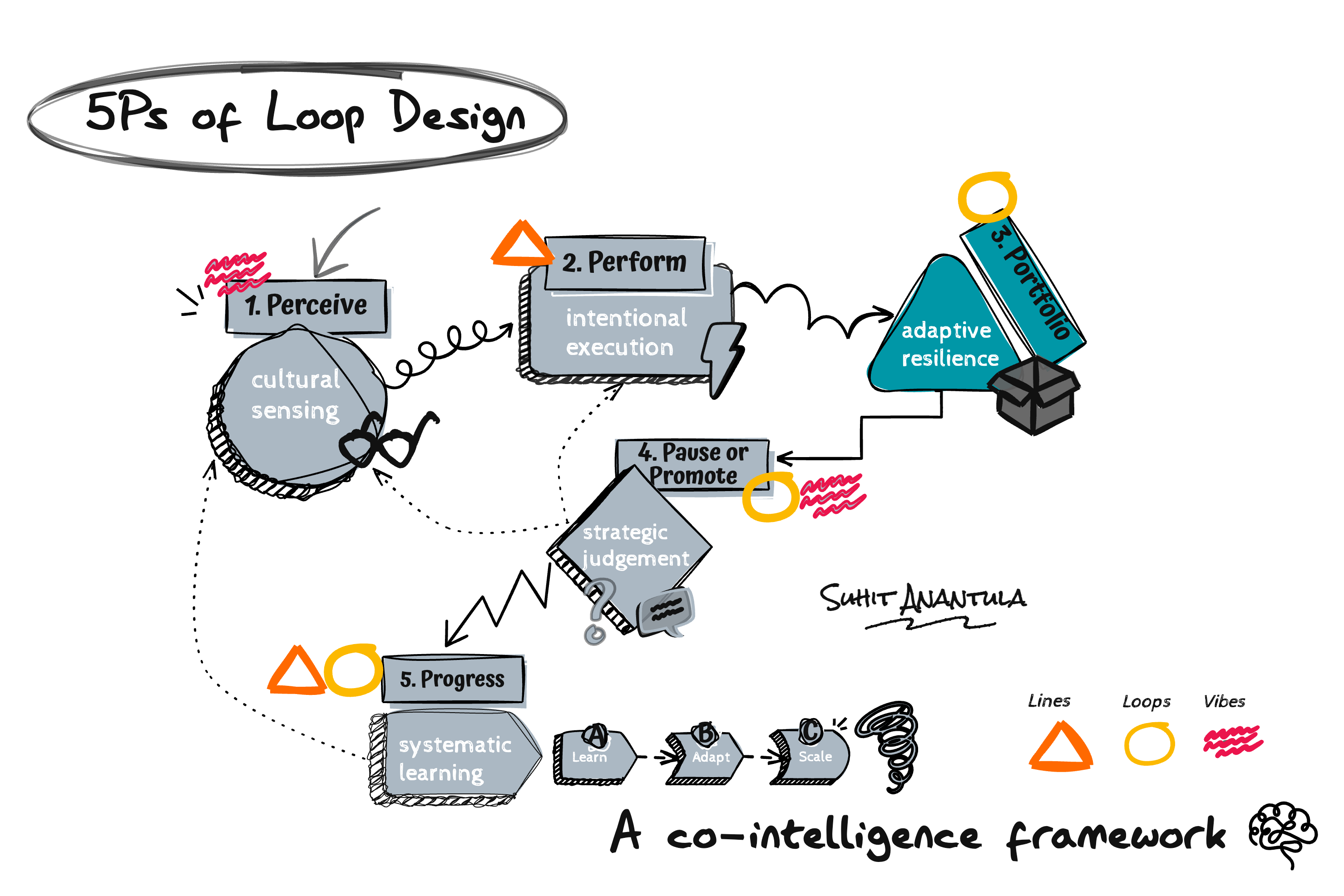
Rule #3: Design for Anti-Fragility
Design begins with perception, continues through action, and then faces a critical juncture: choice.
But in the age of AI, we can't just choose wisely — we must design systems that get stronger from uncertainty.
Design for Anti-Fragility is the rule for organisations that understand the difference between surviving volatility and thriving on it. It's for leaders who recognise that in a world of exponential change, the question isn't how to predict the future—it's how to create systems that benefit from unpredictability.
When facing uncertainty, design for anti-fragility.
Not just resilience. Not just robustness. But systems that actually improve when stressed, that discover opportunity in volatility, that transform disruption into advantage.
The Essence
Portfolio is the third phase of the 5Ps of Loop Design—where we shift from executing single strategies to orchestrating dynamic option systems. But this isn't the portfolio thinking of traditional planning, where we choose between static alternatives. This is anti-fragile portfolio design, where we create systems that learn, adapt, and strengthen through exposure to uncertainty.
In the AI age, portfolio means designing systems that can explore thousands of possibilities simultaneously while getting smarter from every outcome. It's about creating what we call ● adaptive resilience—the manifestation of co-intelligence where human strategic wisdom and AI's exploratory power combine to build systems that thrive on volatility.
The Barbell Strategy Revolution
Think like a portfolio, not a pitch.
Whether you're investing in products, markets, or your own future—the principle is the same: Spread the risk. Span the horizon. Think like a portfolio.
Nassim Taleb calls this the barbell strategy: Place some bets on low-risk, near-term wins—and some on bold, high-upside innovations. Avoid the fragile middle where moderate risks yield moderate returns.
This maps perfectly to design in the AI age. In a portfolio, you don't implement every idea. You explore the edges, see the spread, and begin to notice what's really possible.
But most teams—by habit—move from problem straight to solution. We frame. We fix. We ship.
What's missing is the space between: The part where we generate not one, but many answers. The part where we hold those answers up to the light and ask, "Which of these gives us leverage, not just motion?"
That's what anti-fragile design makes possible. It's not about commitment. It's about ● dynamic curation.
When 1,200 Strategies Beat One Perfect Plan
At a leading hedge fund, they discovered something counterintuitive: Running 1,200+ parallel trading strategies simultaneously outperformed any single "perfect" strategy, no matter how sophisticated.
The challenge was immense: How do you manage thousands of competing approaches to market prediction while maintaining overall portfolio coherence and risk management?
Their solution embodied the essence of Design for Anti-Fragility:
Human strategic contribution: Risk managers defined tolerance thresholds, ethical trading boundaries, and overall portfolio objectives. They established what winning looked like and what principles must be preserved across all strategies. They set the strategic guardrails within which the system could explore and adapt.
AI portfolio contribution: Reinforcement learning algorithms continuously generated, tested, and retired trading strategies within these human-defined parameters. Each strategy operated as an autonomous agent, but their collective behaviour created an anti-fragile system that actually benefited from market volatility and uncertainty.
Results: The firm achieved 34% higher risk-adjusted returns compared to traditional single-strategy approaches, while maintaining lower overall volatility. When individual strategies failed—as many did—the portfolio system grew stronger by learning from those failures and reallocating resources to more successful approaches (Liminary, 2023).
This wasn't diversification for its own sake. This was ● anti-fragile system architecture—building systems that get smarter and stronger from exposure to uncertainty. Each market shock, each failed strategy, each unexpected outcome made the overall system more robust and capable.
"We don't try to predict the market. We create systems that benefit from market unpredictability. Our portfolio gets stronger from volatility, not weaker." — Risk Manager (paraphrased)
Rhythmic Pattern
Portfolio in the 5Ps operates primarily in ● Loops Mode—iterative, adaptive, learning-focused. But it's Loops Mode amplified by AI's ability to run thousands of parallel experiments:
- ● Loops Mode + AI: Continuous portfolio optimisation, parallel strategy testing, adaptive resource allocation based on performance
- ▲ Lines Integration: Systematic frameworks for portfolio evaluation and risk management
- 〰 Vibes Awareness: Ensuring portfolio strategies align with organisational values and market intuition The magic happens when human portfolio strategy (what to optimise for) meets AI exploration capability (how to discover what works at scale).
Co-Intelligence in Portfolio Design
Portfolio design is no longer limited by human analytical bandwidth. It's a partnership that exemplifies co-intelligence—the seamless integration of human strategic wisdom with AI's exploratory capabilities:
- Humans: Define portfolio objectives, set risk parameters, establish ethical boundaries, provide strategic direction
- AI: Generate and test thousands of options simultaneously, optimise portfolio balance, learn from outcomes across parallel experiments
- Together: Create ● adaptive resilience—the practical expression of co-intelligence that gets stronger through uncertainty As accelerant, AI enables exploration of option spaces far beyond human cognitive limits. As connector, AI reveals relationships between strategies that might otherwise remain hidden. As amplifier, AI scales human strategic judgement across complex portfolio landscapes.
Pharmaceutical Pipeline Anti-Fragility
The power of anti-fragile design extends beyond finance into domains like drug discovery—traditionally slow, expensive, and failure-prone.
Consider Atomwise's approach to pharmaceutical development. Instead of betting everything on a few carefully chosen compounds, they created an AI-powered portfolio system that explores vast molecular possibility spaces while learning from every outcome.
Human strategic contribution: Researchers defined disease targets, established therapeutic goals, and provided validation criteria. They brought deep biological understanding and clinical judgement to guide the overall portfolio direction.
AI portfolio contribution: The AtomNet® platform analysed millions of molecular structures simultaneously, predicting interaction patterns with disease-related proteins and continuously optimising the portfolio of development candidates based on emerging data.
Results: Atomwise reports their AI platform can reduce drug discovery timelines by 50% and leads to 30% higher success rates by improving the quality of candidates entering the pipeline. Most importantly, their portfolio approach means that failed compounds strengthen the overall system's understanding rather than representing pure loss (Redress Compliance, 2023).
This demonstrates ● Loops Mode portfolio design—where each experimental outcome, whether successful or not, improves the system's ability to identify promising directions and avoid unproductive paths.
The Anti-Fragility Spectrum
Modern portfolio design operates across a spectrum of anti-fragile capabilities:
Static Portfolio (Traditional approach):
-
Fixed set of predetermined options
-
Manual evaluation and selection processes
-
Linear progression from options to decisions Dynamic Portfolio (AI-augmented):
-
Continuously evolving option sets based on performance data
-
Automated optimisation within human-defined parameters
-
Real-time resource allocation based on emerging results Anti-Fragile Portfolio (Co-intelligence):
-
Systems that strengthen from volatility and uncertainty
-
Self-improving exploration capabilities
-
Portfolio architectures that discover opportunity in disruption The key insight: AI enables us to move from static choice-making to dynamic anti-fragile system design.
Portfolio Across Organisational Functions
Different organisational functions naturally express anti-fragile design through different approaches:
Customer relationship functions create anti-fragile portfolios through diverse engagement strategies, multiple communication channels, and adaptive service models. Their portfolios strengthen from customer feedback variability, learning what resonates across different segments and contexts.
Product innovation functions build anti-fragile portfolios through parallel development tracks, diverse technical approaches, and varied market positioning strategies. Here, AI enables exploration of vast feature combinations while humans provide creative direction and user empathy.
Infrastructure functions design anti-fragile portfolios through redundant systems, alternative operational approaches, and diversified capability sets. AI amplifies their ability to maintain reliability while continuously optimising performance across multiple operational strategies.
The most powerful organisations create portfolio bridges between these functions—enabling learning from one domain to strengthen portfolios in others.
EEE Layer Activation
- Ethical: Ensuring portfolio exploration includes options that serve diverse stakeholder needs and societal benefits
- Emotional: Maintaining authentic human connection across different portfolio strategies
- Emergent: Designing portfolios that can discover and adapt to unprecedented opportunities and challenges These layers ensure that anti-fragile design serves human flourishing, not just optimisation metrics.
From Options to Anti-Fragile Systems
While traditional option generation remains valuable for initial exploration, the AI age demands a new level of portfolio thinking:
Traditional Approach: Generate → Evaluate → Select → Implement Anti-Fragile Design: Design → Deploy → Learn → Evolve → Strengthen
The shift is from static choice-making to dynamic system architecture, enabled by AI's ability to explore and learn at scales impossible for human teams alone.
Practical Methods
- Barbell Portfolio Design: Combine low-risk, reliable strategies with high-potential, experimental approaches
- AI-Powered Strategy Generation: Use AI to continuously create and test new approaches within strategic boundaries
- Dynamic Resource Allocation: Build systems that automatically invest more in successful strategies and retire unsuccessful ones
- Anti-Fragile Feedback Loops: Create learning mechanisms that strengthen from both successes and failures
The Clay Pot Lesson Revisited
A pottery teacher's experiment reveals a profound truth about innovation: The path to quality runs through quantity. The group focused on making many pots—exploring the full space of possibility—produced the highest quality work. Meanwhile, the group focused on perfecting a single pot was constrained by premature optimisation.
But in the AI age, we can take this lesson further. Instead of just making many pots to find the best one, we can create pottery systems that get better at making pots through every attempt. Each "failure" teaches the system something new. Each success reveals principles that can be applied across the portfolio.
This is the essence of anti-fragile design: Systems that transform uncertainty into capability, volatility into advantage, and failures into wisdom.
Common Pitfalls
- Fragile Diversification: Creating options without learning mechanisms
- Optimisation Without Exploration: Focusing only on improving existing strategies
- Complexity Without Purpose: Building elaborate systems without clear strategic objectives
- Scale Without Wisdom: Running many experiments without extracting insights
How to Practice This Rule
Exercise 1: Portfolio Mapping Identify one strategic challenge. Instead of seeking the best solution, design a portfolio approach: What would 70% safe bets look like? What would 30% bold experiments include?
Exercise 2: Anti-Fragile Assessment For a current initiative, ask: How could this get stronger from uncertainty? What would make this benefit from volatility rather than suffer from it?
Exercise 3: Dynamic Resource Allocation Design a system where resources automatically flow toward successful experiments and away from unsuccessful ones. What metrics would drive this? What human oversight would be needed?
Reflect and Reframe
Where is your organisation still thinking "one right answer" when it could be designing for anti-fragility?
What would change if your strategies got stronger from market volatility instead of weaker?
This is the heart of Portfolio in the AI age. It's not about hedging your bets—it's about designing systems that thrive on uncertainty.
When facing the unknown, design for anti-fragility.
Transition: Portfolio to Pause/Promote
Portfolio creates abundant possibilities. It sets the stage for Pause/Promote—where we filter for coherence and meaning across vast option spaces.
References:
- Liminary. (2023). Human-AI Collaboration: Finding the Sweet Spot, Part II.
- Redress Compliance. (2023). AI Case Study: Atomwise - AI in Drug Discovery.
Talk to Helix Nexus
AI Thinking PartnerClick a prompt to copy it and open Nexus. Paste the question into the chat to get started.
Open Helix Nexus GPT