The Helix Moment
AI in the Loop
AI in the Loop 〰
Rhythm Mode: 〰 Vibes
Reader Objective: Develop intuitive intelligence for human-AI collaboration.
When AI Stops Being a Tool
Most people experience AI as a productivity tool.
"It helps me write faster." "It generates ideas when I'm stuck." "It automates routine tasks."
But something shifts when you start using AI regularly.
It stops feeling like a tool and starts feeling like a thinking partner.
You begin to sense what it's good at, what it misses, when to trust it, when to redirect it.
You develop a 〰 collaboration intuition.
This isn't about understanding how AI works technically.
It's about understanding how human-AI collaboration works naturally.
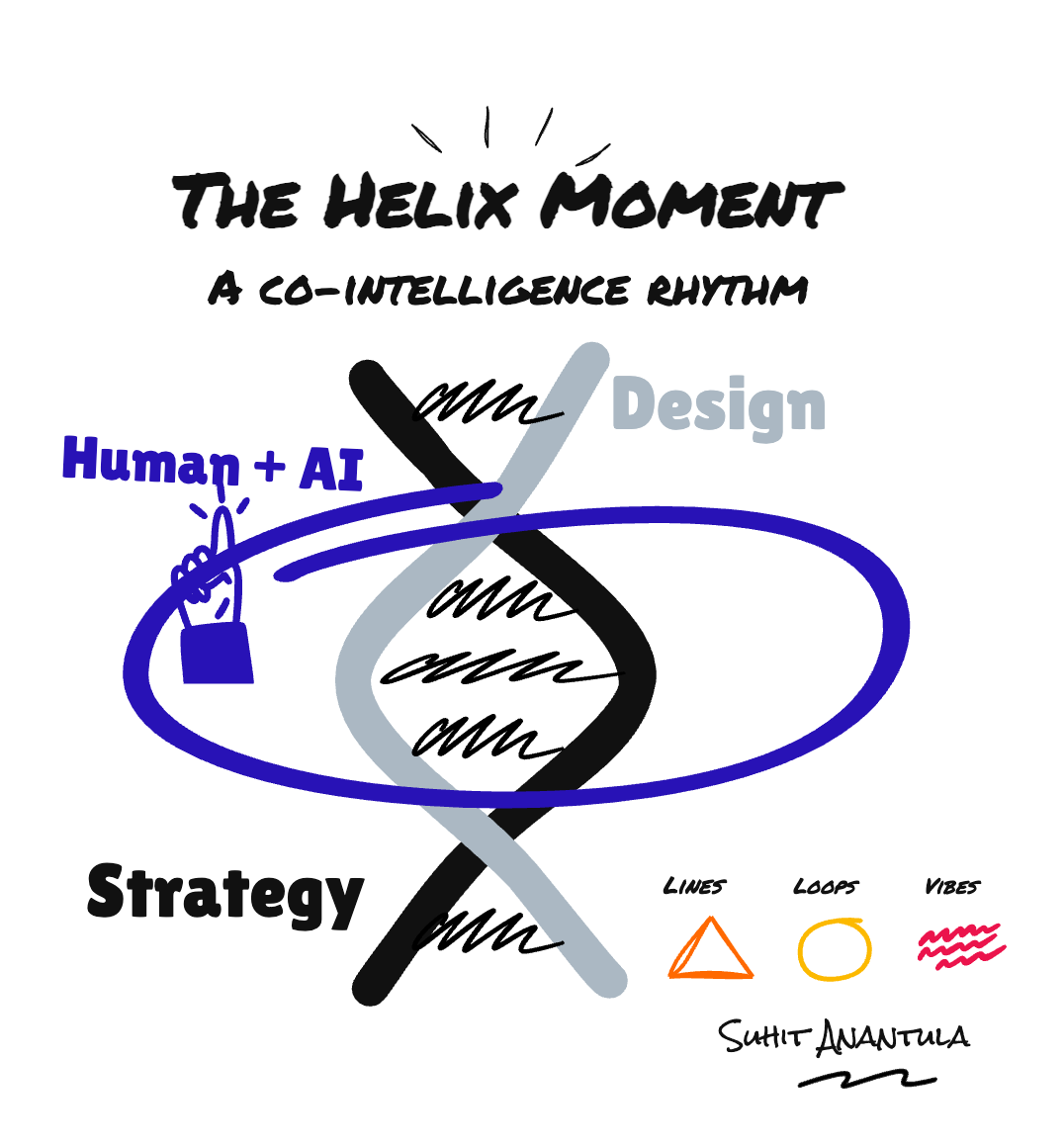
The Dance of Co-Intelligence
After thousands of hours working with AI, patterns emerge:
AI as Rapid Ideator
- Generates volume and variety faster than human cognition
- Best with clear prompts and specific parameters
- Excels at combining existing ideas in new ways
AI as Pattern Connector
- Links insights across domains humans might not notice
- Surfaces connections from massive information sets
- Identifies analogies and frameworks from other fields
AI as Relentless Collaborator
- Never gets tired, distracted, or offended
- Maintains enthusiasm for iteration and refinement
- Processes feedback without emotional resistance
Humans as 〰 Meaning-Makers
- Provide context that AI lacks
- Apply judgement about quality, relevance, wisdom
- Navigate emotional and ethical nuances
- Decide what matters and why
Developing "〰 AI Intuition"
Working with AI effectively requires a kind of sensing ability: 〰 Energy Matching: Different AI interactions require different human energy states
-
For creative brainstorming: Open, experimental, playful energy
-
For analytical work: Focused, systematic, testing energy
-
For strategic thinking: Reflective, questioning, integrative energy 〰 Prompt Intuition: Learning to communicate with AI in ways that produce valuable responses
-
Specific enough to get useful output
-
Open enough to get surprising insights
-
Structured enough to get actionable results 〰 Quality Sensing: Rapidly distinguishing valuable AI output from noise
-
What feels authentic vs. formulaic
-
What integrates well with human insight
-
What serves the actual purpose vs. looking impressive
The Human-AI Spiral
The most effective human-AI collaboration doesn't follow a linear process.
It spirals: Human → poses question, provides context AI → generates options, identifies patterns Human → selects, refines, adds judgement AI → expands, iterates, connects further Human → integrates, decides, applies wisdom
Each loop adds value. Each interaction becomes more sophisticated. The output emerges from the 〰 relationship, not from either intelligence alone.
Four Modes of Human-AI Collaboration
Based on real-world use, I'm sensing four distinct collaboration patterns:
Mode 1: AI as Amplifier
Human leads, AI accelerates
Use case: Content creation, research, analysis
Human role: Set direction, provide judgement, ensure quality
AI role: Generate volume, find information, process data Rhythm: Human intention → AI acceleration → Human curation
Mode 2: AI as Mirror
AI reflects human thinking back for refinement Use case: Problem-solving, strategic thinking, creative development
Human role: Think out loud, test ideas, explore possibilities
AI role: Ask questions, offer perspectives, surface assumptions
Rhythm: Human exploration → AI reflection → Deeper human insight
Mode 3: AI as Partner
True co-creation with shared cognitive load
Use case: Complex problem-solving, innovation, strategic design
Human role: Provide context, wisdom, ethical judgement AI role: Generate options, identify patterns, connect domains
Rhythm: Shared ownership → Iterative building → Emergent solutions
Mode 4: AI as Capability
AI handles entire workflows while human guides high-level direction
Use case: Data analysis, process automation, research synthesis Human role: Define objectives, interpret results, apply insights
AI role: Execute complex workflows, manage information flow
Rhythm: Human strategy → AI execution → Human integration
Sensing the Right Mode
Different challenges call for different collaboration approaches: When you're stuck: Use AI as Mirror to reflect your thinking
When you're overwhelmed: Use AI as Amplifier to increase capacity When you're exploring: Use AI as Partner for true co-creation
When you're executing: Use AI as Capability for workflow automation
The key is sensing which mode serves the moment.
The Emergence Layer
The most interesting human-AI collaboration happens in 〰 emergence space:
Neither human nor AI could produce the result alone. The value emerges from the quality of the interaction.
Example: Strategic scenario planning
- Human provides business context, stakeholder perspectives, cultural nuance
- AI generates multiple scenarios, identifies interdependencies, models outcomes
- Conversation produces insights neither could reach independently
- Strategy emerges that's more adaptive and innovative than traditional planning
Rhythmic Intelligence in AI Collaboration
Different rhythms call for different AI collaboration approaches:
▲ Lines Mode + AI
Structured, systematic collaboration
- Use AI for process acceleration and quality control
- Apply clear frameworks and evaluation criteria
- Focus on efficiency and reliability gains
- Human maintains: Strategic direction and quality standards
● Loops Mode + AI
Iterative, experimental collaboration
- Use AI to accelerate experimentation cycles
- Generate multiple options for rapid testing
- Build learning into each interaction
- Human maintains: Learning orientation and adaptation direction
〰 Vibes Mode + AI
Intuitive, emergent collaboration
- Use AI for pattern sensing and weak signal detection
- Allow unexpected connections to emerge from conversation
- Trust the collaborative process over predetermined outcomes
- Human maintains: Wisdom, judgement, and meaning-making
Practical AI Collaboration Protocols
Starting Protocols
- Define the collaboration mode before engaging
- Set context clearly but remain open to surprise
- Establish quality criteria that matter to you
During Protocols
- Pay attention to what feels generative vs. mechanical
- Trust your 〰 intuition about AI output quality
- Use "Yes, and..." approach to build on AI ideas
Integration Protocols
- Always apply human judgement to AI output
- Look for insights that surprise you
- Adapt your approach based on what emerges
Practice: AI Collaboration Experiment
Objective: Develop your 〰 intuitive intelligence for AI collaboration.
Experiment: Mode Selection (5 min)
-
Choose a current challenge you're working on
-
Which collaboration mode feels most appropriate?
-
What outcome are you hoping for? Collaboration Session (25 min)
-
Engage AI in your chosen mode
-
Pay attention to the quality of interaction
-
Notice when you feel most/least aligned with AI output Integration Reflection (10 min)
-
What emerged that you couldn't have produced alone?
-
What did you learn about AI's strengths/limitations?
-
What did you learn about your own collaboration style? Mode Experimentation (20 min)
-
Try the same challenge in a different collaboration mode
-
How does the process and output change?
-
Which approach feels most generative for you?
Reflection Questions
- What does effective human-AI collaboration feel like for you?
- How has your relationship with AI evolved as you've used it more?
- Where do you sense the most value emerging from AI collaboration?
- What uniquely human capabilities do you bring to the partnership? AI in the loop isn't about AI doing human work. It's about human and artificial intelligence creating value neither could achieve alone.
The future belongs to humans who can sense this 〰 collaboration space intuitively.
Who know when to lead, when to follow, when to redirect, when to integrate.
Who can dance with intelligence in all its forms.
That's not a technical skill. That's 〰 rhythmic intelligence.
Talk to Helix Nexus
AI Thinking PartnerClick a prompt to copy it and open Nexus. Paste the question into the chat to get started.
Open Helix Nexus GPT