The Helix Moment
Why Strategy Needs Rhythm
There was a time when strategy was predictable. Five-year plans. Annual cycles. Quarterly reviews. PowerPoint decks that laid out a future in neat, logical phases.
But the world has moved. And strategy hasn’t kept up.
We now live in a time where ▲ (five-year plans) break against ● (weekly pivots) and 〰 (cultural shifts) no one predicted. Add to that rising emotional complexity, geopolitical uncertainty, and radically shifting work models. In this world, planning the future as if it were stable… feels almost absurd.
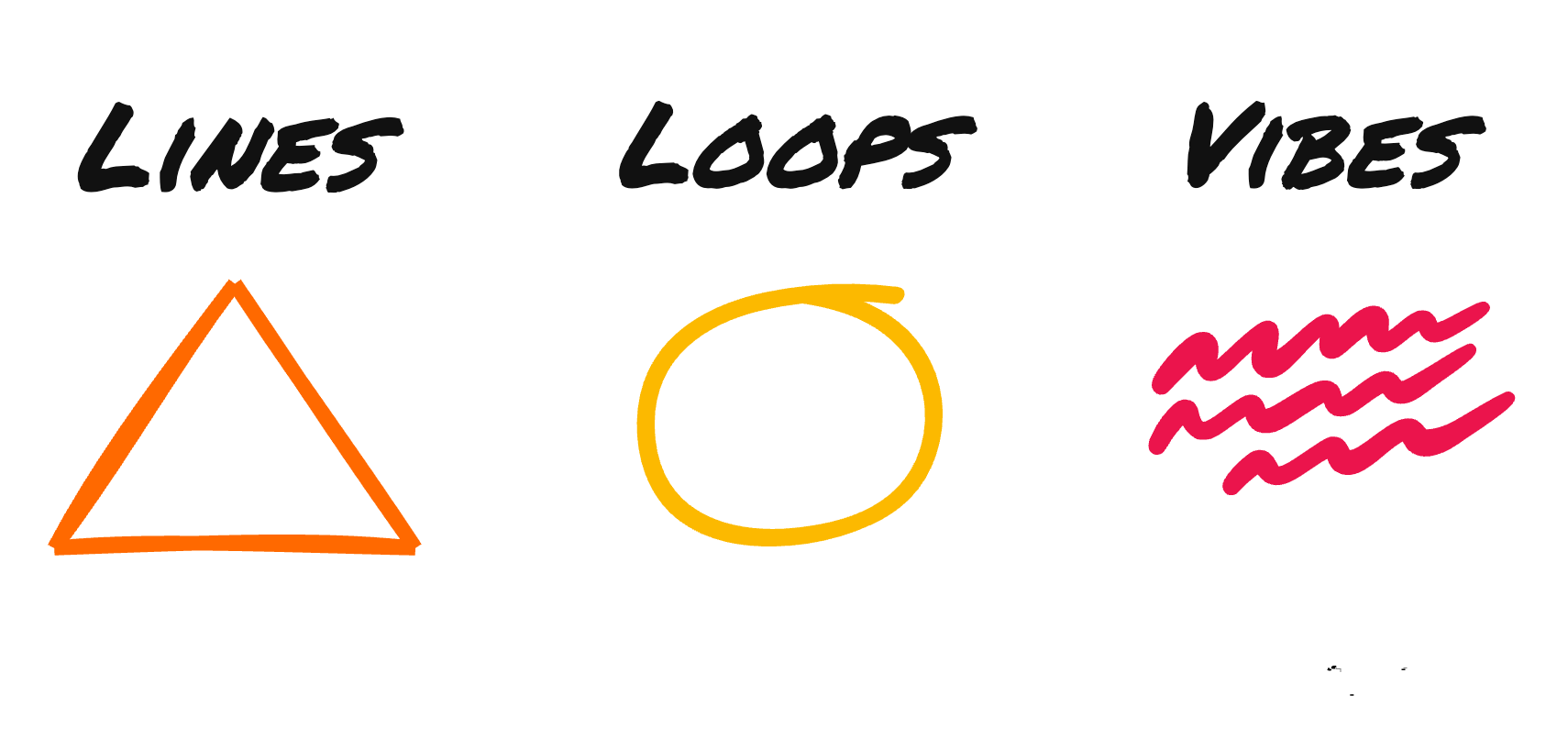
Strategy, as it's traditionally practised, is still built for a world of lines. But we now need strategy that can operate in loops — and increasingly, in vibes.
The Old Tools Break Under Pressure
We saw it clearly during COVID. Companies with rigid five-year strategies found themselves scrambling. Those that had a rhythm — the ability to pause, reframe, adapt — often thrived.
Zara’s Helix Moment: When intuition overruled the 5-year plan
Zara had ▲ linear expansion plans built on physical retail. When lockdowns hit, they shifted to ● rapid experimentation — testing e-commerce, adjusting supply chains weekly, letting user data drive product flow. Their online sales grew by 77% in a single year.
Think of Uber, Airbnb, Netflix. These weren’t just new business models. They were new ways of thinking about value. Responsive. Customer-centred. System-aware.
They moved like the world did.
Spotify operates the same way. Its AI recommendation engine doesn’t rely on static charts. It listens, loops, and adapts in real time — learning from billions of signals to generate fresh experiences every week.
And then there’s Nike. During the height of 2020’s upheaval, they launched the “You Can’t Stop Us” campaign — a bold, emotional move based on 〰 cultural sensing, not market testing. It hit 58 million views in days. That’s a 〰 vibe-led move — strategy as energy, not just execution.
In this environment, the classic tools — rigid KPIs, overengineered dashboards, annual review cycles — can become liabilities. They assume stasis. They focus on what is known, when the world is increasingly shaped by what’s emerging.
Trying to steer with old tools is like navigating a speedboat using a compass designed for an ocean liner.
Why This Book Is Different
Most strategy books give you plans. This book teaches you to move.
Traditional Strategy Books: **Focus on predicting and controlling the future
Treat uncertainty as a problem to solve
Separate strategy from execution
Assume stable environments and rational actors
The Helix Moment**: Embraces uncertainty as creative fuel
Integrates strategy with sensing and adaptation
Recognises that rhythm matters more than perfection
Designed specifically for the Age of AI
This isn't about better planning. It's about learning to move with the world.
From Static to Rhythmic
What we need now is strategy that listens. Strategy that can move with timing, attunement, and feedback. Not as an emergency response — but as a designed capability.
Strategy must shift from being a plan to being a rhythm.
Rhythm allows for movement, but also for pulse — knowing when to act, when to hold, when to improvise. Rhythm allows you to move with uncertainty, not just survive it.
And just like in music, there are different rhythms:
- Lines — structured, predictive, efficient
- Loops — iterative, adaptive, learning-led
- Vibes — emergent, intuitive, emotionally resonant The challenge isn’t just to choose the right one — it’s to know which rhythm your team is stuck in, and which one your context is asking for.
The Opportunity
This book proposes a new way forward — a system that:
- Helps you diagnose your current rhythm
- Gives you a language for strategic movement
- Equips you with tools to shift, realign, and reimagine your path And this begins not with adopting someone else’s method — but with returning to first principles.
So before we dive into frameworks and tools, let’s begin with the mindset shift that underpins it all:
A return to curiosity, clarity, and strategic imagination.
Talk to Helix Nexus
AI Thinking PartnerClick a prompt to copy it and open Nexus. Paste the question into the chat to get started.
Open Helix Nexus GPT