The Helix Moment
Face 6: The AI Fog
Face 6: The AI Fog - We're Unsure How to Use AI in Our Strategy
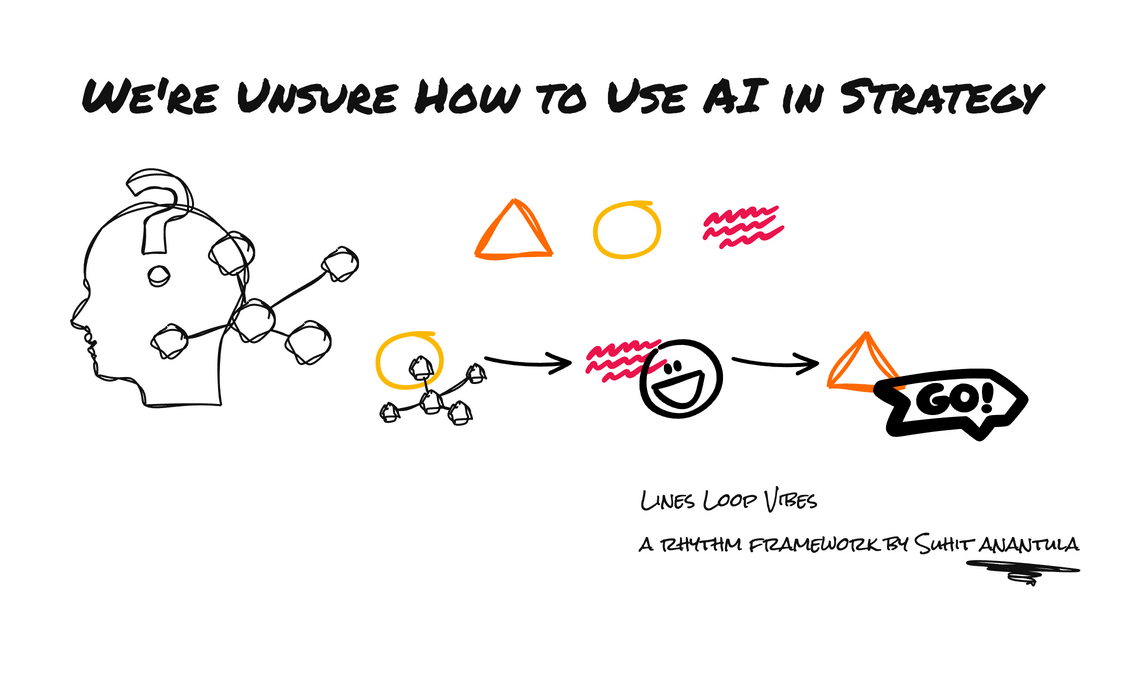
This is how it starts.
The tangled thoughts, the branching possibilities, the question marks multiplying in your head every time someone mentions "AI strategy." You know AI matters, but the path forward feels like a maze of conflicting advice, competing priorities, and uncertain outcomes.
Most leaders experience this exact moment: standing at the intersection of excitement and anxiety, knowing they need to act but unsure which direction leads to breakthrough versus breakdown.
But here's what this visual reveals: there's actually a rhythm to navigating AI uncertainty.
Notice the flow from Loops (experimentation and learning) → Vibes (intuitive understanding and resonance) → Lines (structured action and execution). This isn't random—it's the natural pattern successful organisations follow when transforming AI intimidation into strategic iteration.
The confusion in your head? That's not a problem to solve immediately. It's the starting point for systematic learning.
Here's what might surprise you: Starting with AI uncertainty isn't a weakness—it's a strategic advantage.
MIT Sloan Management Review's research across 3,000+ managers in 112 countries reveals that organisations acknowledging "we don't know how to use AI" and adopting experimental approaches achieve 6x better financial outcomes than those pursuing grand AI strategies. The leaders who succeed don't begin with confidence—they begin with systematic approaches to managing unknowns.
Take Capital One. When Chief Scientist Prem Natarajan faced the same AI uncertainty you're experiencing, he didn't pretend to have all the answers. Instead, he deliberately chose what he calls a "very, very, very careful" implementation strategy, stating: "Everybody acknowledges, across every industry, that they are learning. Everybody is exploring."
Rather than rushing to deploy AI in high-stakes credit decisions, Capital One developed a "stairway to heaven" methodology—embodying the exact rhythm shown in our visual:
Loops: Starting with 10-person pilots for months (experimentation)
Vibes: Expanding to hundreds for weeks (building intuitive understanding)
Lines: Then thousands before enterprise deployment (structured execution)
This measured approach enabled the bank to deploy AI assistants to 20,000+ customer service agents while maintaining regulatory compliance and customer trust.
The confusion you're feeling? Capital One felt it too. The difference is they used it as fuel for systematic learning rather than paralysis.
This chapter is for that moment — the one where excitement and anxiety meet.
It's not a tech issue. It's a learning issue. And a co-creation opportunity.
Reframe the Rhythm
AI uncertainty often emerges when teams: Over-index on experts and under-involve users
Frame AI as a technology decision, not a strategic design question
Move too fast or too vaguely — without rhythm
What's needed is a shift from intimidation to iteration, from control to co-creation.
SAFE Activation: Ambiguity (A) + Co-Creation (S)
AI forces us to: Move without full clarity (A)
Bring multiple voices into shaping what AI could do for us (S)
When JPMorgan Chase developed COiN (Contract Intelligence) to process legal documents, they didn't start with a grand AI strategy. They began with a specific pain point (lawyers spending 360,000 hours annually reviewing loan agreements), invited legal and tech teams to co-create the solution, and embraced the ambiguity of not knowing exactly how AI would transform their legal operations. Today, JPMorgan employs 2,000+ AI specialists with 300+ AI/ML use cases in production, generating $1.5+ billion in business value from AI/ML initiatives.¹
SAFE reminds us that strategy in the AI era is not about perfect planning.
It's about strategic experimentation with shared learning.
Strategy Principle: Strategy as Learning
We don't know the best use of AI for our context until we try.
That's why strategic learning loops — not just bold bets — are so vital.
Strategy is no longer "build and execute."
It's "try, learn, adjust, repeat."
This principle is grounded in frameworks like Lean Startup, Co-Intelligence (Mollick), and Agile experimentation. Financial Times provides a textbook example of this approach. The organisation spent 1.5 months developing an AI-powered newsletter summarization tool that "didn't get the effect we wanted"—a clear failure by traditional metrics. Instead of abandoning AI efforts, they pivoted to create an AI Playground, an interactive platform enabling journalists to drive their own experimentation. This shift from top-down implementation to bottom-up exploration accelerated innovation cycles and generated successful use cases across the newsroom.
The lesson: failed hypotheses provide valuable learning when organisations maintain experimental mindsets.
The MIT Research Validation
Before diving into frameworks, it's worth understanding what distinguishes successful AI adopters from the rest.
MIT Sloan Management Review's longitudinal research identifies three distinct patterns among companies navigating AI uncertainty:
AI Pioneers (12%) combine high understanding with systematic experimentation, achieving financial benefits at 6x the rate of other organisations
AI Investigators (17%) build deep understanding before limited deployment, focusing on capability development
AI Experimenters (13%) adopt a "learning-by-doing" approach with high deployment but initially limited comprehension
Crucially, only organisations combining deployment with systematic organisational learning achieve significant financial returns—pure technology implementation without learning structures fails to generate value.
Mayo Clinic exemplifies this approach. Despite being healthcare's "most aggressive adopter" of AI with 200+ use cases in development, they explicitly acknowledge that AI remains "sufficiently new and experimental" requiring extensive support structures. This admission led to creating a 60-person enablement team supporting 76,000 staff members and establishing an AI Factory for rapid model generation. The result: FDA-approved ECG algorithms reducing 45-minute kidney analyses to seconds while maintaining clinical accuracy.
Field Note: AI Isn’t a Tech Problem. It’s a Strategy One.
Really, what’s a book about AI without talking about AI strategy, right?
But here’s what I keep running into:
I meet with CEOs and they say, “This is interesting. Talk to my CIO or CTO.”
And I get it.
It feels like a technology issue. Something technical.
Something outside the scope of “real” strategic conversation.
But that’s exactly the problem.
Most CIOs and CTOs are already stretched: Maintaining legacy systems
Managing cybersecurity risks
Cleaning up bad data
Overseeing digital transformation programs
Keeping the lights on
They’re critical partners.
But they are not the ones who should lead your AI strategy.
Because AI isn’t about infrastructure.
It’s about intelligent capability.
It’s not about the wiring.
It’s about what you build on top of it.
Saying “talk to the tech team” about AI is like saying:
“Electricity is a wiring issue. Let the electrical guys handle it.”
But electricity didn’t change the world because we understood volts.
It changed the world because we imagined dishwashers, vacuum cleaners, electric vehicles.
That wasn’t a technical decision.
That was a design decision. A business model decision. A strategic choice.
It’s the same with AI.
The CEO doesn’t need to know how the model works.
They need to ask: What could we design, change, or reimagine — if we had intelligence embedded in our system?
That’s not a tech conversation.
That’s the future of strategy.
Framework: Lean Strategy + Co-Intelligence
Lean Strategy (Ries) invites you to:
Treat your AI ideas as hypotheses
Test early, test small, and learn fast
Focus on value creation, not just implementation
Co-Intelligence (Mollick) adds:
Always invite AI to the table
Always keep humans in the loop
Stitch Fix demonstrates how this integration creates competitive advantage. From its 2011 founding, the company pioneered 〰●▲ multi-rhythm AI implementation. The ▲ Lines pattern appears in their systematic recommendation flow: AI algorithms generate suggestions → human stylists refine selections → clients receive shipments. The ● Loops pattern creates continuous feedback cycles where client responses improve both AI algorithms and stylist understanding. The 〰 Vibes pattern emerges when stylists creatively remix AI suggestions for emotional resonance and lifestyle context. This 〰●▲ multi-rhythm approach generated $3.2 billion in 2024 revenue (up from $1.7 billion in 2020) with AI-driven recommendations accounting for 75% of selections sent to customers.²
Together, Lean Strategy and Co-Intelligence create an ethical, experimental, and adaptive posture.
AI Integration Across Rhythmic Modes
Different rhythmic approaches to AI integration serve different strategic purposes:
▲ Lines Mode AI Integration: Structured & Systematic
Establishes clear AI governance and ethical guidelines
Creates standardised implementation frameworks
Develops systematic measurement and evaluation processes
Builds reliable AI infrastructure and operations
● Loops Mode AI Integration: Iterative & Adaptive
Tests AI applications through rapid experimentation
Refines AI capabilities through user feedback cycles
Adapts AI implementations based on learning and results
Builds AI literacy through hands-on experience
〰 Vibes Mode AI Integration: Intuitive & Emergent
Senses cultural readiness for AI adoption
Explores creative AI applications beyond obvious use cases
Develops organisational comfort with AI collaboration
Cultivates intuitive understanding of human-AI balance
JPMorgan Chase demonstrates 〰●▲ enterprise-scale rhythmic integration across departments. Trading operates on ▲ linear algorithms for high-speed transactions. Risk Management employs ● loop-based fraud detection analysing $10 trillion in daily transactions with continuous learning. Customer Service utilises 〰 vibes-based chatbots adapting to emotional context and relationship history. Investment Banking combines all three rhythms: ▲ linear analysis tools, ● iterative market modelling, and 〰 creative deal structuring with AI augmentation.³
Building AI Literacy Through Experimentation
Organisations successfully building AI capabilities share a common approach: they create psychologically safe environments for ● experimentation rather than mandating ▲ top-down training programs.
Johns Hopkins Applied Physics Laboratory's "Level Up" program demonstrates the power of voluntary, gamified learning. Despite APL's reputation as a highly technical organisation, many staff members felt uncomfortable implementing GenAI in daily work. The voluntary program incorporated entertainment elements including a "Labwide Leader Board" and weekly prizes. Results exceeded all expectations: 1,500+ employees completed 6,500+ unique training sessions during the competition period, with an additional 1,000 joining afterward. Total training sessions exceeded 10,000, far surpassing mandatory program benchmarks at peer organisations.
Nestlé's enterprise-wide implementation across 189 countries and 339,000+ employees centred on NesGPT, an internal ChatGPT version enabling secure experimentation. The company created an innovation community of 100+ team members trained on AI concept generation tools, encouraging cross-functional experimentation. Measurable results include 30% reduction in forecasting errors, 30-50% reduction in equipment stoppages through predictive maintenance, and product ideation acceleration from 6 months to 6 weeks.
The shift from intimidation to ● iteration generates superior outcomes in both capability development and cultural transformation.
AI as Strategic Co-Creator
AI transforms strategic integration in three fundamental ways – as accelerant, as connector, and as amplifier:
AI as Strategic Accelerant
Generate and test multiple AI use cases in days instead of months
Rapidly simulate potential ROI across different implementation options
Compress strategic learning cycles from quarters to weeks
Automate competitive analyses to understand AI positioning in your market
AI as Strategic Connector
Bridge implementation gaps between technical and business teams
Link customer pain points directly to potential AI solutions
Translate strategic priorities into specific AI capabilities
Connect organisational knowledge across silos for holistic insights
AI as Strategic Amplifier
Extend strategic imagination beyond conventional AI applications
Surface non-obvious patterns in market and operational data
Challenge assumed limitations with creative alternatives
Expand the horizon of what's possible through unprecedented combinations
AI Prompting for Strategic Integration
Effective prompts for AI strategy development include: Problem Finding: "Analyse our current business model and identify the top 5 operational areas where AI could create the most strategic value for us within 6 months"
Opportunity Mapping: "Generate 10 creative ways we could use AI to solve our [specific challenge], ranging from simple augmentation to radical reinvention"
Risk Assessment: "What are the most likely unintended consequences of implementing AI in our [function]? Include second-order effects and ethical considerations"
Implementation Planning: "Create a staged approach for introducing AI into our strategy process, with specific milestones that balance quick wins with meaningful transformation"
Customer Experience: "How might we use AI to enhance our customer experience while maintaining human connection? Generate 7 concepts that blend automation and augmentation"
Human-AI Collaboration Model for Strategic Integration
Human-Led Strategic Direction
Humans define strategic objectives and ethical boundaries
Humans establish success metrics and implementation criteria
Humans determine organisational readiness and change management approach
AI-Augmented Exploration
AI identifies potential application areas across functions
AI generates implementation options with varying complexity/impact
AI simulates potential outcomes and identifies dependencies
Human-AI Collaborative Evaluation
AI provides initial impact and feasibility assessment
Humans evaluate cultural fit and organisational implications
Joint exploration of ethical considerations using EEE framework
Human-Owned Implementation
Humans make final decisions on where to start
Humans design integration process with stakeholders
Humans determine how to measure success and adjust
Remember: AI excels at identifying patterns and generating options, but humans must determine strategic fit and meaningful integration that aligns with organisational values and capabilities.
Practice: AI Strategy Co-Creation Lab
Objective: Help your team explore, experiment, and define your first or next AI move with appropriate rhythm.
Agenda: Rhythm Check: Where are we today with AI? ▲ Lines (structured), ● Loops (learning), or 〰 Vibes (sensing)? (15 min)
Possibility Space: Use AI + team to generate use cases across functions (30 min)
Customer relationship applications (primarily 〰● Vibes + Loops)
Product innovation applications (primarily ●▲ Loops + Lines)
Infrastructure applications (primarily ▲● Lines + Loops)
Strategic Selection: Choose one use case from each function to develop (20 min)
Rhythm Design: For each use case, design the appropriate rhythm (30 min)
What needs ▲ structure? (Lines)
What needs ● learning? (Loops)
What needs 〰 sensing? (Vibes)
EEE Assessment: Evaluate each using the Ethical-Emotional-Emergent framework (30 min)
Ethical: Does this AI application align with our values and treat stakeholders fairly?
Emotional: How will this change relationships and emotional experiences?
Emergent: How might this AI capability evolve and what should we enable?
Integration Plan: Build a staged approach with clear learning objectives (30 min)
First Move: Choose one initiative to start within the next sprint (15 min)
The goal isn't perfect AI integration.
It's 〰●▲ rhythmic AI learning that becomes part of how you work.
Final Reflection
How might AI change your organisation's rhythm – not just its outputs?
Where in your strategic work could AI create the most meaningful acceleration, connection, or amplification?
What's one small experiment you could run tomorrow to start building your AI strategic muscle?
The evidence is compelling: Organisations adopting experimental approaches achieve 6x better financial outcomes (MIT SMR-BCG research) than those pursuing grand AI strategies. Power users save 30+ minutes daily, with some roles experiencing 5.4 hours of weekly time savings. Stitch Fix generates 10,000 product descriptions every 30 minutes using AI—a task previously requiring days of human effort.
But the transformation goes deeper than productivity metrics. Organisations that embrace AI uncertainty as a strategic starting point develop new organisational capabilities: increased risk tolerance, celebration of "intelligent failures," and democratised access to AI tools. As Coursera's CLO noted about their GenAI Academy: "stories are more impactful than data" for driving adoption—highlighting how cultural transformation requires emotional engagement beyond rational metrics.
You don't need an AI strategy.
You need a 〰●▲ strategic rhythm for AI.
Start small. Co-design with intention.
And let AI become part of how you move – not just what you do.
References
Constellation Research Inc. (2024). JPMorgan Chase: Digital transformation, AI and data strategy sets up generative AI. https://www.constellationr.com/blog-news/insights/jpmorgan-chase-digital-transformation-ai-and-data-strategy-sets-generative-ai
Stitch Fix Newsroom. (2024). How We're Revolutionizing Personal Styling with Generative AI. https://newsroom.stitchfix.com/blog/how-were-revolutionizing-personal-styling-with-generative-ai/
AIX | AI Expert Network. (2024). Case Study: JPMorgan is Setting the Standard for AI Adoption in Banking. https://aiexpert.network/jpmorgan-ai/
Ransbotham, S., et al. (2019-2022). MIT Sloan Management Review and Boston Consulting Group AI Research Series. https://sloanreview.mit.edu/projects/winning-with-ai/
Euromoney. (2024). Prem Natarajan on Capital One's AI stairway to heaven. https://www.euromoney.com/article/2eh2s01l11023kmxtleyo/fintech/prem-natarajan-on-capital-ones-ai-stairway-to-heaven/
INMA. (2024). Financial Times' AI Playground tool allows newsroom to experiment. https://www.inma.org/blogs/conference/post.cfm/financial-times-ai-playground-tool-allows-newsroom-to-experiment
Talk to Helix Nexus
AI Thinking PartnerClick a prompt to copy it and open Nexus. Paste the question into the chat to get started.
Open Helix Nexus GPT