The Helix Moment
The Strategic Navigation Challenge
The Strategic Navigation Challenge
"The problem isn't that we don't have enough information. The problem is that we don't know what type of information challenge we're facing."
Every strategic leader faces the same fundamental question: How do you make decisions when you don't know what you don't know?
This isn't a new challenge. In 2002, Donald Rumsfeld articulated what strategists have always grappled with: "There are known knowns; there are things we know we know. We also know there are known unknowns; that is to say we know there are some things we do not know. But there are also unknown unknowns—the ones we don't know we don't know."
What Rumsfeld didn't explain was how to navigate between these different types of knowledge challenges.
Most strategic failures occur not because organisations lack capability, but because they apply the wrong approach to the wrong type of knowledge challenge. They try to plan their way through ambiguity, experiment their way through established problems, or sense their way through execution challenges.
The result? Predictable patterns of strategic dysfunction.
The Three Domains of Strategic Knowledge
Every strategic challenge exists within one of three knowledge domains. Each requires a fundamentally different approach:
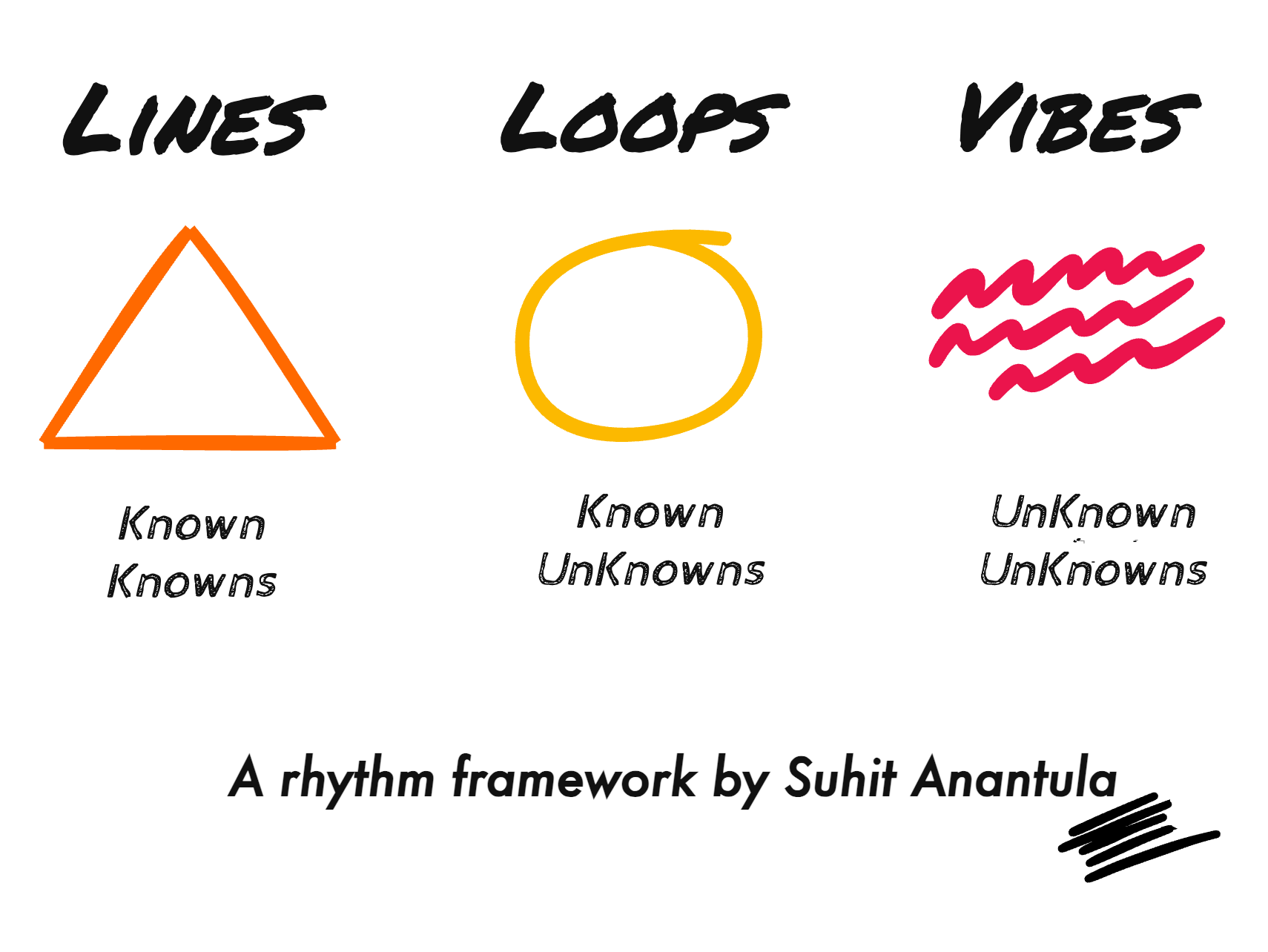
Known Knowns: The Domain of Execution
When we know what works and how to do it
Examples: Scaling proven business models, optimizing established processes, delivering consistent customer experiences
Strategic Approach: ▲ Lines Mode - Structured, systematic execution
▲ Clear processes and standardised approaches
▲ Efficiency optimisation and quality control
▲ Systematic scaling and reliable delivery
AI's Role:
Process automation for routine strategic tasks
Performance optimisation of established systems
Quality monitoring and exception detection
Predictive maintenance of strategic capabilities
Known Unknowns: The Domain of Learning
When we know what we need to figure out
Examples: Testing new market opportunities, developing product features, improving customer retention
Strategic Approach: ● Loops Mode - Iterative experimentation and learning
● Hypothesis-driven testing and validation
● Rapid prototyping and feedback cycles
● Progressive learning through controlled experiments
AI's Role:
Rapid experimentation acceleration and A/B testing
Pattern recognition across iterations and data
Predictive modeling for hypothesis testing
Learning synthesis from multiple experiments
Unknown Unknowns: The Domain of Sensing
When we don't know what we don't know
Examples: Emerging market disruptions, cultural shifts, breakthrough innovation opportunities
Strategic Approach: 〰 Vibes Mode - Strategic sensing and emergence
〰 Environmental scanning and weak signal detection
〰 Cultural and emotional pattern recognition
〰 Intuitive sensing of what wants to emerge
AI's Role:
Weak signal detection from vast data sources
Cross-domain pattern recognition beyond human cognitive limits
Sentiment analysis and cultural trend identification
Scenario generation for exploring possibilities
When Navigation Goes Wrong
Here's what we've discovered: Most strategic dysfunction occurs when organisations operate in the wrong mode for their knowledge challenge.
Common Mismatches: Using ▲ Lines (planning) for Unknown Unknowns (sensing challenges)
Using ● Loops (experimenting) for Known Knowns (execution challenges)
Using 〰 Vibes (sensing) for Known Knowns (structured delivery challenges)
The symptoms are predictable: Analysis paralysis when sensing is needed
Endless experimentation when execution is required
Rigid planning when adaptation is essential
But here's the opportunity: When you can correctly diagnose which knowledge domain you're operating in, you can choose the appropriate rhythmic response and integrate AI as an amplifier rather than a distraction.
The Strategic Intelligence System
LLV becomes your strategic navigation system: Lines Mode handles what you know how to do well
Loops Mode discovers what you need to learn
Vibes Mode senses what you don't yet know to look for
AI enhances each mode by amplifying human capabilities rather than replacing strategic judgment. The result is co-intelligence - human wisdom combined with machine processing power, calibrated to the specific type of knowledge challenge you're facing.
The Seven Patterns of Navigation Failure
What happens when strategic navigation goes wrong? The same dysfunctional patterns emerge again and again across organisations, industries, and contexts.
We've identified seven fundamental patterns - predictable ways that rhythm-knowledge mismatches create strategic breakdown. Each represents a specific type of navigation failure that can be diagnosed, understood, and systematically addressed.
These aren't unique organisational problems.They're recognisable patterns of strategic dysfunction.
Once you can see the pattern, you can work with the pattern.
Once you can work with the pattern, you can transform it.
Field Note: Embracing Strategic Framework Diversity
So why don't we just have one strategic framework?
Why not just teach the best model and be done with it?
It's a fair question — and it's exactly why I took a different path in this book.
There are entire books written about a single framework.
But that's not how real strategy happens — not in my experience, not in yours.
After more than two decades of working in strategy and design, I've learned this:
What works depends on what you're facing, who you're with, and where you are in the rhythm of the work.
Some frameworks are powerful in moments of clarity.
Others help us find coherence in chaos.
Some are about choice. Others about emergence.
Rather than saying, "Here's the best one," I wanted to offer something different:
A diagnostic way in
A design-led approach to choosing your frameworks
A system that starts not with method — but with pain
What's the strategic tension you're facing?
Where is your team stuck?
What kind of movement do you need next?
That's why we start with pain points.
Because the pain is the doorway to posture — and from there, to your framework.
In every project I've worked on, I've never once reused the same framework in the same way.
Instead, I ask: What is this moment asking of us?
That's what I hope this book offers you — not just strategy, but strategic rhythm.
Not just principles, but plurality.
And not just a map — but a way to find your footing as the world moves.
Talk to Helix Nexus
AI Thinking PartnerClick a prompt to copy it and open Nexus. Paste the question into the chat to get started.
Open Helix Nexus GPT