The Helix Moment
The Multi-Rhythm Organisation
The CEO looked confused. "Our innovation team moves fast, but manufacturing can't keep up. Marketing wants to experiment, but finance needs predictability. It feels like everyone's dancing to different music."
The consultant nodded. "They are. And that's not necessarily a problem."
"What do you mean?"
"Different parts of your business need different rhythms. The challenge isn't making everyone move at the same pace—it's orchestrating those differences."
This chapter is about sensing that orchestration. The tensions between functions. The clash of cultures. The struggle to be both stable and dynamic.
It's not a failure of management.
It's a failure of 〰 rhythm awareness.
Let's explore what might be emerging.
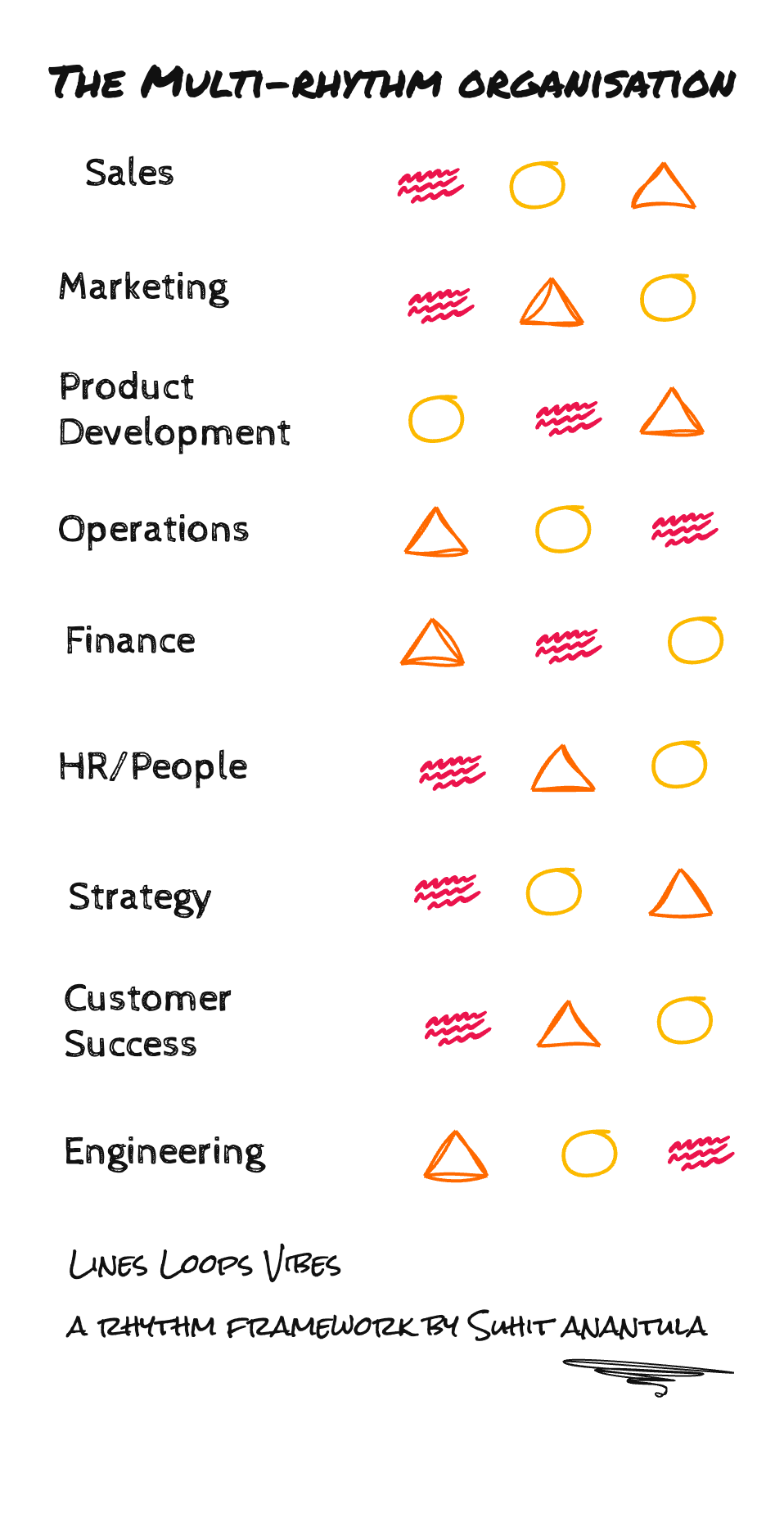
Reframe the Rhythm
I'm starting to notice something: Organisations struggle when they try to force a single rhythm across diverse functions:
Finance operates in ▲ Lines but innovation needs ● Loops
- Operations thrives on ▲ Lines while customer experience requires 〰 Vibes
- Leadership might envision in 〰 Vibes while middle management needs to execute in ▲ Lines What if you don't need organisational uniformity?
What if you need 〰 rhythm orchestration?
I'm sensing that great organisations aren't mono-rhythmic. They might be multi-rhythmic by design.
SAFE Activation: Ambiguity (A) + Emergence (E)
This feels like a moment to: Embrace the inherent tensions between different functional rhythms (A)
- See organisational design as an emergent property of rhythmic harmony (E) Organisation isn't something you impose.
It's something you 〰 orchestrate.
Strategy Principle: Strategy as Orchestra
Most business frameworks assume harmony.
"Get everyone aligned."
"March to the same beat."
But what if different parts of your business should move to different rhythms—and the strategic challenge is not uniformity but 〰 orchestration?
In symphony, the conductor doesn't make all instruments play the same note. They create harmony across difference.
A strategic organisation might sound like this:
- Product Development: Fast, iterative, loop-driven → ● Loops Mode
- Operational Excellence: Systematic, reliable, refined → ▲ Lines Mode
- Brand and Culture: Sensing, resonant, responsive → 〰 Vibes Mode
- Leadership: Orchestrating all three rhythms → ●〰▲ Multi-Rhythm Intelligence This requires leaders who can sense:
- Which function needs which rhythm when
- How to translate between different organisational languages
- When to let tensions exist and when to bridge them
Framework: Multi-Rhythm Organisation Design
I'm starting to sense a framework emerging. A map for thinking about functional rhythms.
Finance / Operations: ▲ Lines Excellence
Purpose: Predictability and Excellence
Rhythm Characteristics:
- Monthly/Quarterly cycles
- Process optimisation
- Risk management
- Continuous improvement AI Role:
- Predictive analytics
- Process automation
- Risk detection
- Performance optimisation Culture:
- Rigour
- Reliability
- Efficiency
- Standards
Product / R&D: ● Loops Excellence
Purpose: Learning and Innovation
Rhythm Characteristics:
- Sprint cycles (1-4 weeks)
- Rapid experimentation
- Customer feedback loops
- Iterative learning AI Role:
- Rapid prototyping
- A/B testing acceleration
- Pattern recognition in user data
- Hypothesis generation Culture:
- Experimentation
- Learning from failure
- Speed of iteration
- Customer-centric
Brand / Culture / Strategic Sensing: 〰 Vibes Excellence
Purpose: Sensing and Resonance
Rhythm Characteristics:
- Real-time sensing
- Cultural awareness
- Emotional intelligence
- Timing sensitivity AI Role:
- Sentiment analysis
- Trend detection
- Weak signal identification
- Cultural pattern recognition Culture:
- Intuition
- Presence
- Authenticity
- Connection
Multi-Rhythm Integration Patterns
The magic happens at the intersections: ▲ Lines + ● Loops = Continuous Improvement
Operations learns from product experiments to refine processes systematically.
● Loops + 〰 Vibes = Resonant Innovation
Product development senses cultural shifts to guide experimentation directions.
〰 Vibes + ▲ Lines = Principled Adaptation
Culture and brand insights inform operational design decisions.
●〰▲ Multi-Rhythm Leadership = Orchestration
Leaders translate between functional languages and orchestrate rhythm timing.
Real-World Examples
Amazon: Multi-Rhythm Mastery
Operations (▲ Lines): Six Sigma fulfillment. Systematic warehouse automation.
Product (● Loops): Two-pizza teams. Rapid experimentation. A/B testing everything.
Culture (〰 Vibes): Customer obsession. Day 1 mentality. Long-term thinking.
Leadership: Bezos as ●〰▲ multi-rhythm conductor. "Working Backwards" methodology to orchestrate across rhythms.
Google: Rhythm Coordination
Engineering (● Loops): 20% time. Rapid experimentation. Fail fast.
Operations (▲ Lines): Massive infrastructure. Systematic scaling. Reliability engineering.
Culture (〰 Vibes): "Don't be evil" → sensing mission drift. Cultural evolution.
Leadership: Balancing innovation freedom with operational excellence.
Rhythm Clash Diagnostics
Symptom: "Innovation is too slow"
Diagnosis: Innovation team stuck in ▲ Lines rhythm when they need ● Loops
Symptom: "Operations is inconsistent" Diagnosis: Operations trying to operate in ● Loops when they need ▲ Lines
Symptom: "Leadership seems out of touch"
Diagnosis: Leadership operating in ▲ Lines/● Loops without 〰 Vibes sensitivity
Symptom: "Teams don't collaborate"
Diagnosis: No rhythm translation protocols between functions
AI as Multi-Rhythm Enabler
AI can help orchestrate across rhythms: Cross-Functional Intelligence
-
Translate insights between different functional languages
-
Bridge timing gaps between fast/slow functions
-
Identify rhythm mismatches before they become conflicts Organisational Sensing
-
Monitor each function's rhythm health
-
Detect when functions are out of sync
-
Suggest rhythm adjustments based on business context Rhythm Optimisation
-
Model scenarios where different rhythm combinations work best
-
Identify optimal timing for cross-functional collaboration
-
Enable real-time rhythm coordination
Practice: Multi-Rhythm Diagnostic
Objective: Map your organisation's current rhythmic profile and identify optimisation opportunities.
Process: Function Mapping (30 min)
List your key organisational functions and their current rhythms:
-
What rhythm does each function naturally operate in?
-
What rhythm does their work actually require?
-
Where do you see mismatches? Integration Assessment (20 min)
-
Where do functions need to collaborate?
-
What rhythm clashes are causing friction?
-
What translation protocols currently exist? Multi-Rhythm Opportunity (25 min)
-
Which functions could benefit from rhythm diversification?
-
What new capabilities might emerge from better orchestration?
-
Where might AI help bridge rhythm gaps? Orchestra Design (25 min)
-
If you were the conductor, how would you orchestrate these rhythms?
-
What would change if you embraced rather than eliminated rhythm differences?
-
What's one experiment you could run to test multi-rhythm coordination?
Reflection Questions
- Does your organisation try to force rhythmic uniformity where diversity might be more effective?
- What would it feel like if different functions were consciously designed for their optimal rhythms?
- How might you develop "rhythm translation" capabilities between functions?
- Where in your organisation is the conductor role missing? The future belongs to leaders who can sense the rhythm each situation requires—and orchestrate harmony across difference.
Multi-rhythm organisations don't eliminate tension.
They turn it into music.
Talk to Helix Nexus
AI Thinking PartnerClick a prompt to copy it and open Nexus. Paste the question into the chat to get started.
Open Helix Nexus GPT