The Helix Moment
Perceive: Never Forget the People
〰 Cultural sensing - reading unspoken needs and emerging patterns
"The real voyage of discovery consists not in seeking new landscapes, but in having new eyes." — Marcel Proust
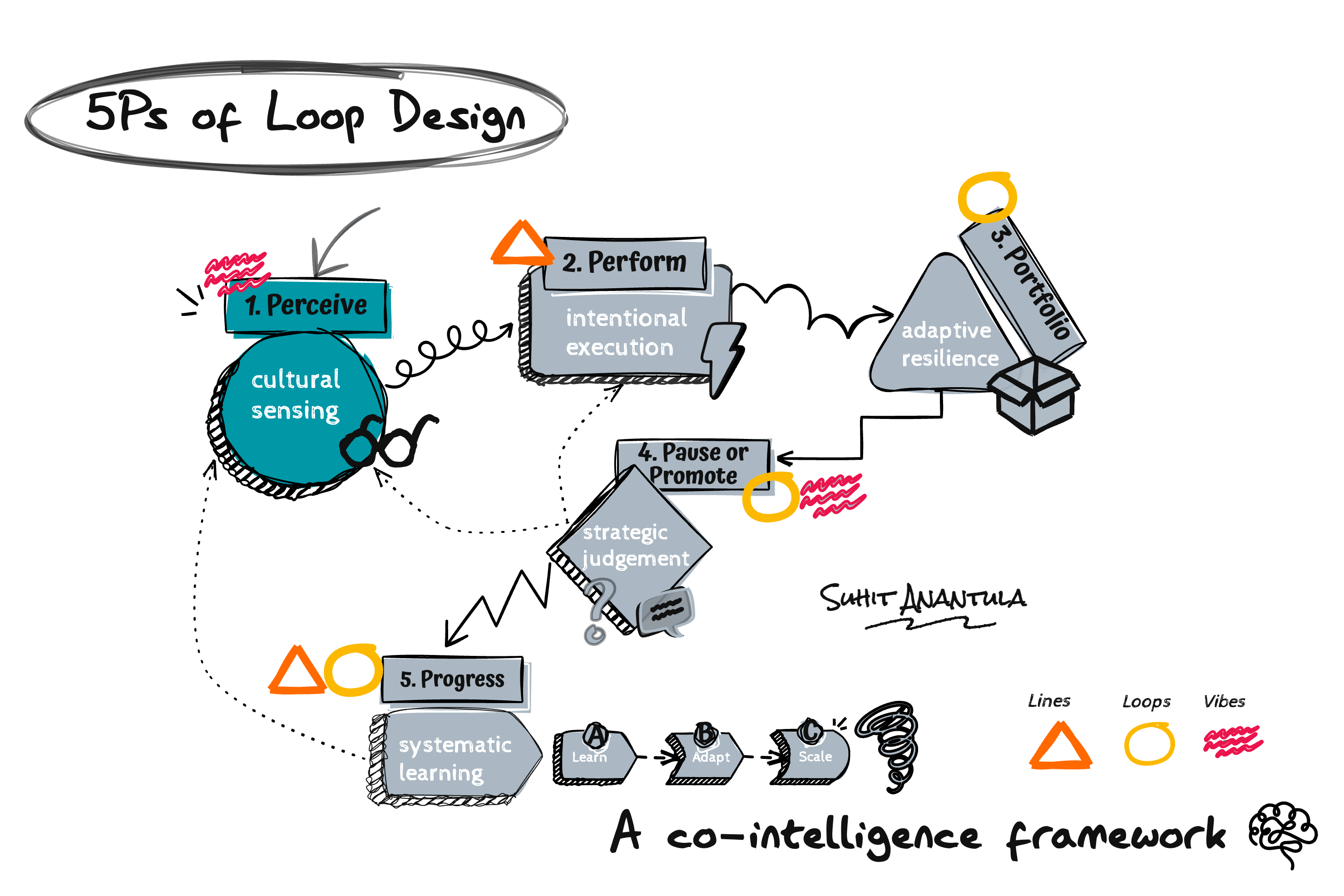
Rule #1: Never Forget the People
It might seem obvious, but in practice, it's easy to forget.
Tools become templates. Deadlines override dialogue. Personas replace presence.
This rule grounds us back in the most human of instincts: empathy.
"Empathy is at the heart of design. Without the understanding of what others see, feel, and experience, design is a pointless task." — Tim Brown
Design begins with perception — with how we see. But in complexity, we can't just see differently — we must see more deeply.
Perceive is the first phase of the 5Ps of Loop Design. It's where we begin not with answers, but with attention. It's the practice of listening before doing. Of feeling before fixing. Of remembering that all design begins with the people we're designing for — and designing with.
The Essence
Perceive is the act of deep sensing that precedes meaningful action. It's where we build understanding before building solutions. Without perception, design becomes disconnected from human reality—solving the wrong problems beautifully or the right problems poorly.
Perceive grounds our designs in lived experience, not assumptions. And in the age of AI, that grounding must come from rhythm—not just research. It's about learning how to sense across multiple modes, in teams, and with machines.
Rhythmic Pattern
The way we perceive shifts dramatically depending on which rhythm drives our approach. This isn't about choosing one mode, but rather understanding how each reveals different aspects of reality.
- ▲ Lines Mode: Structured research frameworks, consistent measurement approaches, standardised documentation
- ● Loops Mode: Iterative exploration, questioning assumptions, progressive discovery cycles
- 〰 Vibes Mode: Intuitive sensing, emotional undercurrents, cultural patterns, weak signals The masters of perception don't choose between these modes – they dance between them. They use ▲ structure to ensure they don't miss the expected, ● loops to discover the hidden, and 〰 vibes to sense the emerging. In that dance, perception becomes not just information gathering, but revelation.
Human–AI Collaboration
Perception is no longer a solo act. It's a duet between:
- Humans: Bring lived experience, cultural sensitivity, ethical judgement, contextual understanding
- AI: Offers pattern recognition, scale, anomaly detection, memory, tireless processing
- Together: They create what we call co-intelligence — the ability to perceive more deeply, act more wisely, and design with greater understanding As accelerant, AI dramatically increases the velocity and volume of perception. As connector, AI reveals relationships that might otherwise remain hidden. As amplifier, AI extends perception beyond human cognitive limits.
But here's the thing: AI can help us sense what's happening. Only humans can decide why it matters.
When Lives Depend on Better Seeing
Dr. Sarah Chen had seen thousands of chest X-rays in her fifteen years as a radiologist. But on this Tuesday morning, something felt different about the case on her screen. A 34-year-old teacher, no symptoms, routine screening. The image looked... normal.
Almost.
Her AI diagnostic partner had flagged a subtle shadow in the upper left quadrant—barely perceptible, the kind of pattern that could easily be dismissed as image noise or benign tissue variation. But the system had learned from analysing over 100,000 similar cases, detecting patterns no human eye could track alone.
Dr. Chen paused. Her clinical experience told her the patient's age and lack of symptoms made cancer unlikely. But her AI partner's pattern recognition was suggesting otherwise. She decided to order additional imaging.
The follow-up CT scan revealed early-stage lung cancer—stage I, highly treatable, caught years before symptoms would have appeared.
This scene plays out daily across healthcare systems where radiologists and AI systems have formed a new kind of partnership. Singh's 2025 meta-analysis of 94 studies found that this collaboration is transforming medical diagnosis: radiologists using AI assistance detected 22.7% more early-stage malignancies while reducing false positives by 18.4% compared to unassisted interpretation (Singh, 2025).
This was 〰▲ diagnostic intelligence in action. Dr. Chen's 〰 clinical intuition (years of experience reading subtle patterns) combined with AI's ▲ structured recognition (analysing 100,000+ cases systematically). Clinical wisdom met computational scale.
The result: 〰▲ integrated perception that created a smarter, more human system that saved lives.
"The integration of AI in healthcare isn't about replacing human judgement—it's about enhancing it. When physicians and AI systems work together, we see faster diagnoses, fewer errors, and more personalised treatment plans." — Dr. Michael Strzelecki, Medical Imaging Expert
Strategic Sensing at Enterprise Scale
Meanwhile, in the boardroom of a major European automotive manufacturer, executives faced a different kind of perception challenge. With €40 billion in annual sales and the automotive industry transforming rapidly around AI and electrification, they needed to sense where artificial intelligence could support—or disrupt—their operations.
But instead of rushing into AI implementation, they chose to start with strategic sensing.
Over several months, the leadership team engaged in what researchers call "prospective sensemaking"—a systematic process of perceiving potential futures before they fully materialised. They mapped their entire value chain, from supplier relationships to customer service, asking a crucial question: Where could human-AI collaboration create value, and where might it create risk?
The process revealed 63 potential AI use cases across their operations. But more importantly, it flagged 7 high-risk applications where AI might misread human emotions, where customers preferred human interaction, or where the cultural context was too complex for algorithmic interpretation (Sudeeptha et al., 2024).
This was ▲〰 systematic sensing with cultural awareness. A deliberate ▲ structured approach that maintained 〰 sensitivity to human elements and cultural context. This rhythm combination revealed not just opportunities—but ethical blind spots that could have derailed their entire AI transformation.
"We weren't choosing tools. We were choosing futures." — Strategy Executive (paraphrased)
The systematic mapping didn't just identify where AI could help—it helped executives perceive the human elements that must be preserved. In customer-facing roles, they sensed that empathy and cultural understanding remained distinctly human capabilities. In safety-critical systems, they perceived the need for human oversight and judgement.
Perceive Across Organisational Functions
Different parts of your organisation naturally perceive through different lenses, each attuned to their primary purpose and rhythm:
Customer relationship functions excel at 〰 cultural sensing - reading emotional undercurrents, community dynamics, unspoken expectations. But they need ▲ systematic frameworks to scale these insights and ● experimentation to test cultural assumptions across diverse segments.
Product innovation functions thrive on ● experimental discovery - testing assumptions, exploring user behaviours, iterating on feedback. But they need 〰 user intuition to sense what matters and ▲ structured validation to ensure reliability.
Infrastructure functions perceive through yet another lens. They notice system performance patterns, efficiency bottlenecks, and scale challenges. ▲ Lines perception provides their foundation.
The magic happens when these perceptual rhythms connect. Create intentional rhythm bridges: 〰 customer sensing informing ▲ infrastructure planning, ● product experimentation guided by 〰 cultural intuition, ▲ systematic analysis enhanced by ● adaptive learning. These connections create organisational intelligence greater than any single function.
EEE Layer Activation
- Ethical: Perceiving long-term impacts, power dynamics, value misalignments
- Emotional: Sensing trust, resonance, and tension
- Emergent: Detecting patterns before they fully form These layers make perception more than observation. They make it wisdom.
Practical Methods
- AI-Enhanced Empathy Mapping: Merge human interviews with sentiment analytics
- Cross-Modal Perception: Interpret images, language, behaviour in one loop
- Strategic Sensing Teams: Blend trend detection with executive foresight
- Evidence Synthesis Collaboration: Research shows human-AI teams identify relevant literature with 24% higher recall and 19% greater precision compared to either working independently (Spillias et al., 2024)
Common Pitfalls
- Automation Without Interpretation: Using AI for data but skipping human meaning
- Single-Rhythm Perception: Over-relying on one mode (just 〰 Vibes or just ▲ Lines)
- Disconnection from Strategy: Failing to connect sensing to action
- Scale Without Empathy: Losing human connection as organisations grow
How to Practice This Rule
Exercise 1: The Empathy Deep Dive: Use AI sentiment tools to analyse user feedback. Then interview 3 people. What does AI surface that humans miss? And vice versa?
Exercise 2: Cross-Rhythm Sensing: Pick one challenge your organisation faces. Examine it through ▲ Lines (structured analysis), ● Loops (iterative questioning), and 〰 Vibes (intuitive sensing). Notice what each reveals.
Exercise 3: AI-Powered Personas: Feed anonymised user feedback into clustering tools to generate diverse persona types. Refine with real-world human input.
Reflect and Reframe
Think about a time you felt truly understood by a service or product. What made it feel that way?
Now think of a time something missed you completely. What did the designer fail to see?
This is the heart of Perceive. It's not about research. It's about respect.
And from that place, the most powerful design emerges.
Transition: Perception to Performance
Perceive creates the foundation for action. It sets the stage for Perform—where strategic insight transforms into systematic execution.
- In crisis, this transition happens fast
- In complexity, it takes time
- In creativity, it flows intuitively
References:
- Singh, N. (2025). Enhancing Search and Discovery: The Synergistic Collaboration Between Humans and AI. European Journal of Computer Science and Information Technology, 13(10), 112-123.
- Spillias, S. et al. (2024). Human-AI collaboration to identify literature for evidence synthesis. ScienceDirect.
- Sudeeptha, I. et al. (2024). Use Cases for Prospective Sensemaking of Human-AI-Collaboration. Victoria University of Wellington.
Talk to Helix Nexus
AI Thinking PartnerClick a prompt to copy it and open Nexus. Paste the question into the chat to get started.
Open Helix Nexus GPT