The Helix Moment
Perform: Move with Intention
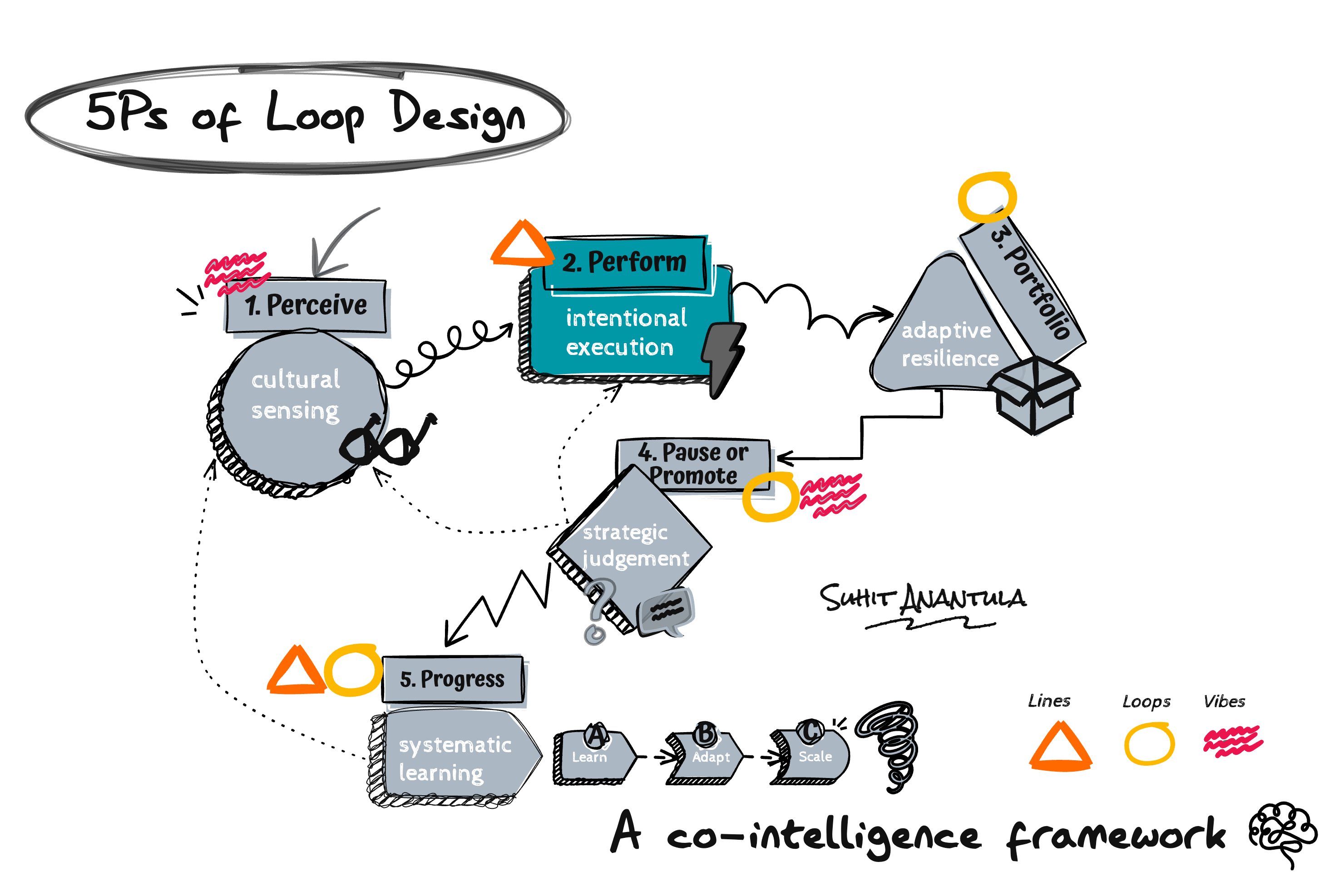
▲ Intentional execution - converting insights into concrete action
"The journey of a thousand miles begins with a single step." — Lao Tzu
Rule #2: Move with Intention
Design begins with perception, but it cannot end there.
In the age of AI, insight without action is a kind of delay. A postponement of learning. A deferral of truth.
Move with Intention is the rule for organisations ready to execute at the speed of intelligence itself. It's for leaders who understand that in a world of AI-augmented performance, the question isn't whether to act—it's how to act with strategic precision at machine speed.
When you have clarity, move decisively.
Not tentatively. Not experimentally. With the full force of human strategic intent amplified by AI's execution capabilities.
The Essence
Perform is the second phase of the 5Ps of Loop Design—where strategic insight transforms into systematic action. But this isn't the performance of traditional project management or cautious prototyping. This is performance at scale, where human intention meets machine execution.
In the AI age, performance means designing systems that can execute thousands of decisions per minute while staying true to human values and strategic direction. It's about creating what we call ▲ execution intelligence—a manifestation of co-intelligence where human wisdom and AI capability combine to act with both speed and strategic precision.
The Decision Factory Revolution
At Marimekko, the Finnish design company known for bold patterns and vibrant colours, executives faced a modern challenge: how to deliver personalised customer experiences across their digital channels while maintaining the human creativity and aesthetic judgement that defined their brand.
With revenue of €152 million and over 20% year-over-year growth, much of it driven by digital channels, Marimekko had already invested heavily in customer-centric technology. They had product recommendations and proprietary analytics since 2018, marketing mix modelling since 2019, and computer vision-backed immersive services by 2021.
But in 2022, they made a different kind of move. Instead of building another isolated feature, they created what they called a "Decision Factory"—an AI-powered system that could make thousands of tactical decisions in real-time while staying aligned with human strategic intentions.
The challenge was complex: How do you personalise everything from front-page banners to discount amounts to product categories, while ensuring each decision reflects Marimekko's distinctive aesthetic and brand values?
Their solution embodied the essence of Move with Intention: Human strategic contribution: Marimekko's executives and designers defined the business rules, revenue targets, brand guidelines, and aesthetic principles. They established what success looked like and what values must be preserved. They identified key customer segments—those interested in sustainability, new collections, different sub-brands like Kioski—and set the strategic boundaries for AI decision-making.
AI execution contribution: Reinforcement learning agents operated within these human-defined parameters, making real-time decisions about which banner to show, what discount to offer, which products to recommend. The system ingested a real-time event stream from marimekko.com, triggering learning processes every 10 minutes to continuously optimise performance.
The results spoke to the power of human intention + machine execution:
- 41% lift in front-page clickthrough rates within hours of launch—without pre-training
- 24% increase in average revenue per user after five weeks
- A scalable system that could optimise "virtually any tactical decision with a finite set of choices" This wasn't prototyping. This was ▲ performance architecture—building systems that execute strategic intent at machine speed while preserving human judgement where it matters most.
"We're not just automating decisions—we're scaling strategic thinking. The AI executes thousands of choices, but every choice reflects our creative vision and business principles." — Marimekko Executive (paraphrased)
Rhythmic Pattern
Performance in the 5Ps operates primarily in ▲ Lines Mode—structured, systematic, execution-focused. But it's Lines Mode amplified by AI capabilities:
- ▲ Lines Mode + AI: Systematic execution at machine speed, consistent application of strategic principles, scalable performance across thousands of decisions
- ● Loops Integration: Continuous learning and optimisation within execution systems
- 〰 Vibes Awareness: Ensuring execution systems preserve human values and aesthetic judgement The magic happens when human strategic intention (what to optimise for) meets AI execution capability (how to optimise at scale).
Co-Intelligence in Performance
Performance is no longer limited by human bandwidth. It's a partnership that exemplifies co-intelligence—the seamless integration of human and artificial intelligence capabilities:
- Humans: Provide strategic direction, define success criteria, set ethical boundaries, maintain aesthetic judgement
- AI: Execute tactical decisions at scale, learn from outcomes, optimise within human-defined parameters
- Together: Create ▲ execution intelligence—the practical expression of co-intelligence in action As accelerant, AI enables execution of thousands of decisions per minute. As connector, AI translates strategic intent into tactical actions. As amplifier, AI scales human judgement across complex decision landscapes.
Compliance at Machine Speed
The power of AI-augmented performance extends beyond customer experience into domains like regulatory compliance—traditionally slow, manual, and resource-intensive processes.
Consider a financial services firm facing new regulatory requirements. Traditionally, compliance teams would spend months manually reviewing policies, cross-referencing regulations, and identifying gaps. The process was thorough but painfully slow.
Enter AI-augmented compliance performance:
Human strategic contribution: Compliance officers identified priority risk areas, defined validation criteria, and established the regulatory framework. They provided the contextual understanding of business operations and the judgement needed to prioritise findings.
AI execution contribution: AI systems analysed over 300 internal controls against new regulatory texts, cross-referencing policies with regulatory requirements at unprecedented speed and scale.
Results: The firm achieved a 70% reduction in compliance gap analysis time while maintaining the thoroughness that human oversight provides (Savkín, 2023).
This demonstrates ▲ Lines Mode performance—systematic execution that translates strategic intent (regulatory compliance) into scalable action (automated policy analysis) while preserving human judgement where it matters most (risk prioritisation and validation).
The Spectrum of Performance
Modern performance operates across a spectrum, from experimental prototyping to scaled execution systems:
Experimental Performance (Traditional prototyping):
-
Testing concepts through rapid experiments
-
Learning through making small, tangible expressions
-
Validating assumptions before commitment Pilot Performance (Limited deployment):
-
Testing systems with real users in controlled environments
-
Validating human-AI collaboration patterns
-
Refining execution parameters Scaled Performance (Full deployment):
-
Executing strategic intent through AI-powered systems
-
Operating thousands of decisions within human-defined boundaries
-
Continuous optimisation while preserving strategic direction The key insight: AI enables us to move rapidly from experimental to scaled execution.
Perform Across Organisational Functions
Different organisational functions naturally express performance through different approaches: Customer relationship functions perform through personalised interactions, dynamic communication strategies, and real-time service optimisation. Their performance focuses on relationship building and emotional connection—areas where AI can scale human intention while preserving authentic connection.
Product innovation functions perform through rapid feature development, A/B testing at scale, and continuous product optimisation. Here, AI enables exploration of vast possibility spaces while humans provide creative direction and user empathy.
Infrastructure functions perform through systematic process optimisation, predictive maintenance, and operational excellence. AI amplifies their ability to maintain reliability and efficiency while humans provide strategic oversight and exception handling.
The most powerful organisations create performance bridges between these functions—enabling insights from one area to inform execution in others.
EEE Layer Activation
- Ethical: Ensuring AI execution systems operate within ethical boundaries and preserve human values
- Emotional: Maintaining authentic human connection even within automated systems
- Emergent: Designing systems that can adapt and learn while staying aligned with strategic intent These layers ensure that performance at scale doesn't sacrifice the human elements that create meaning and value.
Practical Methods
- Decision Factory Design: Create systems that execute tactical decisions within strategic boundaries
- AI-Augmented Process Optimisation: Use AI to scale human expertise across operational domains
- Real-Time Learning Systems: Build feedback loops that improve performance while maintaining strategic alignment
- Execution Intelligence Dashboards: Monitor AI performance while preserving human oversight and intervention capabilities
From Prototyping to Performance Architecture
While prototyping remains valuable for exploration and validation, the AI age demands a new level of performance thinking:
Traditional Approach: Build → Test → Learn → Iterate Performance Architecture: Design → Deploy → Optimise → Scale
The shift is from cautious experimentation to confident execution, enabled by AI's ability to learn and adapt within human-defined parameters.
Common Pitfalls
- Automation Without Intention: Using AI for efficiency without strategic direction
- Scale Without Wisdom: Optimising metrics without preserving human values
- Speed Without Learning: Moving fast without building adaptive capabilities
- Execution Without Ethics: Scaling performance without considering broader impacts
How to Practice This Rule
Exercise 1: Decision Mapping Identify one area where your organisation makes repeated tactical decisions. Map what could be systematically executed versus what requires human judgement.
Exercise 2: Intention Definition For a current project, clearly articulate: What strategic outcomes do you want? What principles must be preserved? What can be optimised by AI?
Exercise 3: Performance Spectrum Analysis Take one initiative and map it across the spectrum: What parts need experimental performance? Pilot performance? Scaled performance?
Reflect and Reframe
What decisions is your organisation making repeatedly that could be systematically executed while preserving strategic intent?
Where are you still prototyping when you could be performing at scale?
This is the heart of Perform in the AI age. It's not about cautious experimentation—it's about confident execution at the speed of co-intelligence.
When you have strategic clarity, move with intention.
Transition: Performance to Portfolio
Perform creates execution capability and demonstrates what's possible. It sets the stage for Portfolio—where we design anti-fragile systems that thrive on uncertainty.
References:
- Friedland, B. & Kartela, J. (2023). AI Augmented: A Family of Modern Decision-Making Approaches. Thoughtworks.
- Savkín, A. (2023). Internal Controls Management and Automation. BSC Designer Platform. LinkedIn post.
Talk to Helix Nexus
AI Thinking PartnerClick a prompt to copy it and open Nexus. Paste the question into the chat to get started.
Open Helix Nexus GPT